


Yes, you can send books by books courier service, both within India and to most countries abroad. Books are one of the easiest items to ship: they do not leak, spoil or break, and printed matter is treated favourably by customs in many destinations. The two things that go wrong are avoidable. Books get damaged because they were packed in a bag instead of a box, and parcels cost more than expected because an oversized carton was billed by its volume rather than its weight.
This guide explains how to pack books properly, how courier charges are worked out, when India Post is the better option, what changes when books go abroad, and what to tell a courier so you get an accurate quote. If you are sending books from Chennai, Galaxy International Couriers in Mylapore can collect, pack and dispatch them for you, and the details to share are at the end.
Table of Contents
Who Sends Books by Courier?
Most book parcels fall into one of these situations, and the right packing and service depend on which one you are in:
- Students and parents: textbooks, exam guides and reference books sent to a hostel in another city or a university abroad.
- Readers and families: a novel for a friend, a set of Tamil books for a relative overseas, religious texts, children’s books.
- Authors, publishers and bookstores: copies to readers, retailers or libraries, sometimes in bulk.
- Schools, colleges and institutions: reference sets, journals and printed study material.
A single paperback and a 12 kg carton of textbooks are different shipments. The sections below separate them where it matters.
How to Pack Books Safely for Courier
Books are damaged in transit in three ways: moisture, bent corners and cracked spines. Every step below prevents one of them.

- Keep them dry first. Slide each book into a clean polythene bag or wrap it in plastic film before any other layer. Chennai humidity and monsoon transit through sorting hubs are enough to wave the pages of an unprotected paperback. This single layer is the cheapest protection you can add.
- Wrap each book individually. A layer of bubble wrap or thick kraft paper around each book stops covers rubbing against each other when several are packed together. One layer is enough for ordinary books; save foam and double wrapping for hardcovers you care about.
- Choose the right outer packaging. A padded mailer is acceptable for a single light paperback. Hardcovers, textbooks and anything over roughly half a kilogram belong in a rigid corrugated carton, because a mailer offers no protection to the spine. For multiple heavy books, use a double-wall carton so the base does not give way when boxes are stacked.
- Fit the box to the books. Choose the smallest carton the books fit in flat. Fill any remaining gaps with crumpled paper or bubble wrap so nothing shifts. If you can feel the books move when you shake the box gently, add more filling or use a smaller box.
- Protect hardcover corners. Fold small cardboard corner guards over the corners of hardcovers and coffee-table books. Corners are the first thing to crush when a box is dropped on its edge.
- Seal and label. Tape every seam, including the centre seam and both edges on top and bottom. Write or print the full delivery address with PIN code and a working phone number, and keep a copy of the address inside the box in case the outer label is damaged.
If packing is the part you would rather not do, Galaxy’s international packing service in Chennai can carton and cushion the books at the branch or at pickup. Mention that the parcel contains books so the right carton is used.
One Book vs a Box of Books
A single book is simple: bag it, wrap it, place it in a snug mailer or small box, and send it by any tracked service. Weight is low, so cost is driven mainly by distance and speed.
Several books in one carton change three things:
- Weight climbs quickly. Ten paperbacks weigh 3 to 4 kg; a set of engineering textbooks can pass 10 kg. Heavier parcels usually move more economically by surface than by air within India, and the per-kilogram rate often falls as weight rises on international routes.
- The carton must carry the load. Use double-wall board and do not fill one box beyond what one person can lift comfortably. Two medium boxes are easier to handle than one overloaded box.
- Consolidation saves money. Sending five books in one parcel is almost always cheaper than five separate parcels. Only split a shipment if one box would be too heavy or large to handle safely.
For bulk consignments from a publisher, school or bookstore, tell the courier the number of cartons, the weight of each and whether a delivery challan or invoice must travel with the goods.
How Book Courier Charges Are Worked Out
There is no fixed “books rate”. A courier quote for books depends on:
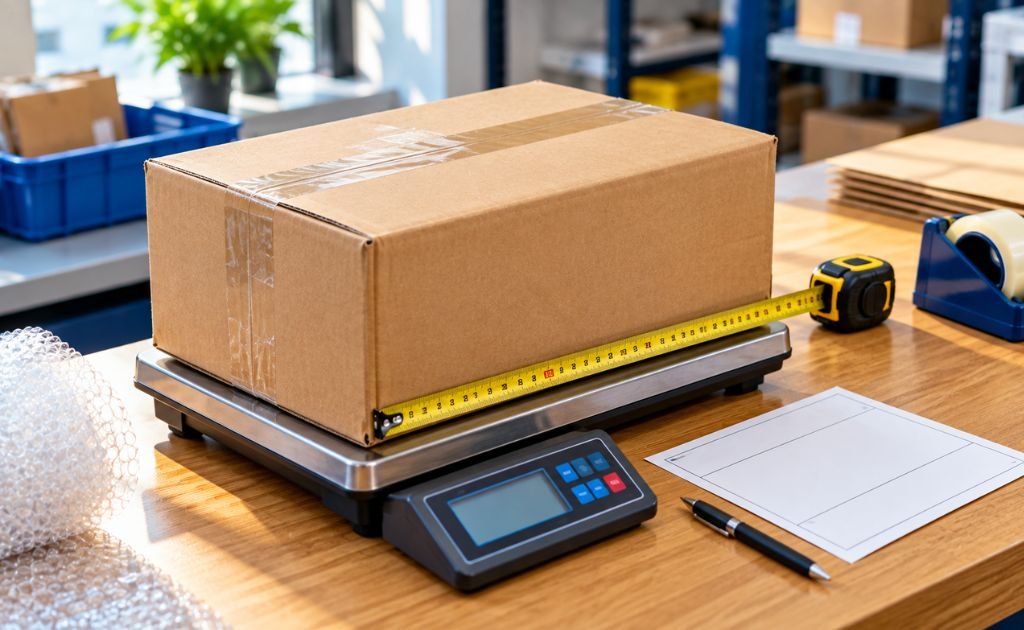
- Chargeable weight. Couriers bill on whichever is higher: the actual weight on the scale or the volumetric weight of the box. For domestic air shipments in India, volumetric weight is usually calculated as length × width × height in centimetres divided by 5,000. A 700 g textbook in a tight 22 × 15 × 4 cm mailer is billed at 700 g. The same book in a loose 30 × 25 × 10 cm box works out to 1.5 kg volumetric and is billed at 1.5 kg. Using the smallest box that fits is the biggest saving available on book parcels.
- Destination. Within Chennai, within Tamil Nadu, rest of India, and each international zone are priced differently.
- Service speed. Surface or economy is cheaper and slower; air or express costs more. Books rarely need express unless an exam or semester date is close.
- Pickup and extras. Doorstep collection, packing materials, insurance on declared value and, for international parcels, any destination duties or handling fees.
To get an accurate quote, weigh the packed parcel on a bathroom or kitchen scale and measure the three outer dimensions of the box. Guessing the weight is the most common reason a quoted price changes at booking.
Courier or India Post? Book Post and Gyan Post Explained
India Post has two products designed for books, and for the right shipment they are hard to beat on price. They also have conditions that rule out many parcels. Rules and rates below were checked against the India Post website on 14 October 2026; confirm at the post office before booking, as they can change.
| India Post Book Post | India Post Gyan Post | Courier service | |
| What qualifies | Books, magazines, journals, printed papers, documents | Syllabus textbooks, competitive-exam books, and social, cultural or religious literature | Any books, commercial or personal |
| Weight range | Up to 5 kg | 300 g to 5 kg | Typically no upper limit for books; confirm per route |
| Key conditions | Must be posted open or in an unfastened cover so it can be inspected; no letters or money inside; marked “Book Post” | Trackable, surface mode only; no periodicals; no books of a commercial nature; each book must show the printer or publisher; marked “Gyan Post” | Sealed parcel, doorstep pickup, tracking, insurance options |
| Published rate | ₹4 for the first 50 g, ₹3 for every additional 50 g | From ₹20 (up to 300 g) to ₹100 (up to 5 kg), plus applicable taxes | Quoted per shipment on weight, size and destination |
| Suits | A few books where cost matters more than speed or tracking | Eligible educational and religious books sent domestically | Sealed, tracked, time-bound, bulk, international, or anything that does not meet the postal conditions |
Two points trip people up. First, a Book Post item cannot be sealed shut, which many senders are uncomfortable with for a valuable book. Second, Gyan Post is not for everything printed: if postal staff find the contents ineligible, the packet is re-charged as a normal parcel with a penalty. A courier service makes sense when you want the box sealed, collected from your door, tracked to delivery, or delivered on a date, and it is the usual route for commercial consignments and anything going abroad.
Books Courier Service: Abroad From Chennai
Printed books are generally allowed into most countries and are often free of import duty, but the treatment is set by the destination, not by India. Treat every international book parcel as a declared shipment:
- Describe the contents specifically. “4 engineering textbooks, English, personal use” clears faster than “books”. Religious and political titles should be described by title in some countries.
- Declare an honest value. Most personal book parcels carry a modest declared value, but a rare or signed edition should be declared at its real replacement value if you want it insured.
- Carry the right paperwork. Personal shipments usually need the courier’s declaration form and the sender’s ID. Commercial shipments from a publisher or seller need a commercial invoice with item descriptions and values, and the seller’s IEC where applicable.
- Pack for a longer journey. International parcels pass through more hands and more climates. Use a double-wall carton and the moisture layer described above, even for paperbacks.
- Allow for destination charges. Duty may be zero, but local tax or a courier handling fee can still apply to the receiver depending on the country and the declared value.
Galaxy ships personal parcels and documents through its overseas courier service from Chennai to the USA, UK, Canada, Australia, Singapore, the Gulf and Europe, and already handles student consignments of books and academic documents. Destination rules and transit times vary by country and service, so confirm them for your specific parcel before dispatch.
How to Get a Book Courier Quote From Chennai
Share these details and you will usually get a firm quote in one message rather than a back-and-forth:
- Pickup location (or whether you will drop the parcel at the Mylapore branch)
- Destination city, or country and city for international
- Number and type of books (paperback, hardcover, textbooks, bulk cartons)
- Packed weight and the box dimensions, if already packed
- Whether the books are personal or a commercial consignment
- The date the parcel needs to arrive, if there is one
Send those details through the contact form, or call the Mylapore branch between 9:30 AM and 9:00 PM.
Mistakes That Damage Books or Raise the Cost
- Sending a hardcover in a padded mailer. The spine bends within a day of normal handling.
- Skipping the plastic layer in monsoon months, then receiving wavy pages.
- Using a large spare carton “to be safe” and paying for air you shipped.
- Writing “books” on an international declaration with no detail.
- Under-declaring value to save a little tax and then having no basis for a claim.
- Posting a commercial consignment as Gyan Post and paying the penalty on delivery.
Pre-Dispatch Checklist for Book Parcels
- Each book bagged against moisture and individually wrapped
- Rigid carton, correctly sized, gaps filled, no movement
- Hardcover corners protected
- All seams taped; full address with PIN code and phone number; copy inside
- Parcel weighed and measured after sealing
- For international: contents described specifically, value declared honestly, documents ready
- Service chosen: postal product (if eligible) or courier with pickup and tracking
- Booking receipt and tracking number kept until delivery
Frequently Asked Questions
Can I send books by courier in India?
Yes. Books are accepted by courier services across India. Pack them in a rigid box with moisture protection and share the parcel weight and size when booking.
How much does it cost to courier books?
It depends on chargeable weight (actual or volumetric, whichever is higher), destination and speed. A single paperback across India costs far less than a carton of textbooks sent abroad. Ask for a quote with the packed weight and box dimensions.
Can I send several books in one parcel?
Yes, and it is usually cheaper than separate parcels. Use a double-wall carton for heavy sets and keep each box to a weight one person can lift.
Is India Post Book Post suitable for every book shipment?
No. Book Post is limited to 5 kg, must be posted unsealed for inspection and cannot contain letters. Gyan Post covers only eligible educational, cultural and religious books, by surface, up to 5 kg. Commercial consignments, sealed parcels and international shipments generally go by courier.
Does the price depend on weight or box size?
Both. Couriers bill the higher of actual and volumetric weight, so an oversized box can cost more than the books warrant. Use the smallest carton the books fit in.
Can I send textbooks to a student studying abroad from Chennai?
Yes. Describe the books specifically on the declaration, declare an honest value, and allow for economy transit times unless a term date is close. Galaxy already handles student book and document consignments from Chennai; confirm the destination’s requirements before dispatch.
What information do I need to book?
Sender and receiver addresses with phone numbers, number and type of books, packed weight and dimensions, destination, and whether the shipment is personal or commercial.
Send Your Books With Galaxy International Couriers
Whether it is one novel to Bengaluru or a carton of textbooks to a university in Canada, Galaxy can advise on packing, confirm the right service for the destination, and give you a quote before anything is dispatched.
Contact Details
- Address: No. 7, R.K. Mutt Road, Mylapore, Chennai – 600 004
- Hours: 9:30 AM – 9:00 PM