
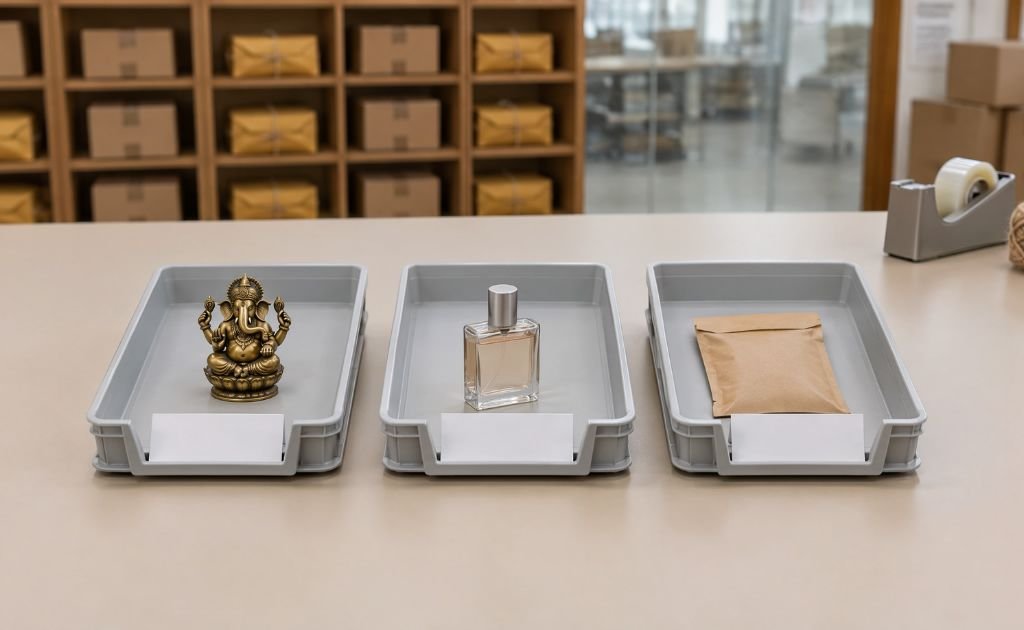

Three different bodies decide which items are not allowed in international courier from India. Indian law decides what may leave the country, the carrier decides what it will carry on an aircraft, and the destination country decides what may enter. Most parcels refused at a Chennai courier counter fail on the second or third rule, not the first, which is why advice from friends so often contradicts itself.
This guide sorts the items into those three tiers, links each one to the body that wrote the rule, lists the parcels Chennai senders are refused most often, and explains what happens when a prohibited item is found.
Table of Contents
What items are not allowed in international courier from India?
The short answer is that it depends on which of three rulebooks the item falls under.
| Tier | Who decides | Where the rule is written | What it looks like at the counter |
|---|---|---|---|
| 1. Prohibited or restricted for export from India | Government of India | ITC-HS Export Policy Schedule 2, Customs Act, RBI regulations, Antiquities and Art Treasures Act, Wildlife Protection Act | The courier cannot book it at all, or asks for a licence or certificate you do not have |
| 2. Not accepted by express carriers | DHL, FedEx, UPS, Aramex, India Post and the air rules they follow | Each carrier’s prohibited and restricted items page, built on IATA dangerous goods rules | Refused as dangerous goods, cash, valuables or live items, however well packed |
| 3. Restricted or prohibited on arrival | The destination country | That country’s customs, food safety, biosecurity and medicines pages | Accepted in Chennai, then held, destroyed or returned at the other end |
Galaxy International Couriers books international parcels through partner carriers DHL, FedEx, UPS, Aramex, ICL and DPD to over 220 countries, and the check it runs before accepting a parcel follows the same three tiers. The International Courier Services section of our services page describes the service; this guide is the rulebook behind it.
What is the difference between prohibited and restricted items?
The words mean different things depending on who is using them, and page 1 of Google mixes them up.
In Indian export policy, DGFT’s own guide to reading Schedule 2 defines Prohibited as not permitted to be exported, with no licence given in the normal course, and Restricted as export permitted under a licence granted by DGFT. Everything not listed is free to export.
For a carrier, prohibited means it will not carry the item under any circumstances, and restricted means it will carry it only with prior agreement, extra packaging or documents. DHL Express India’s prohibited and restricted items page splits its list exactly that way.
For a destination, prohibited means the item cannot enter and restricted means it can enter with a permit or certificate. Abu Dhabi Customs, for example, defines the two terms and lists food products, cosmetics and medicines as restricted, needing prior approval from the authority concerned.
The same item can sit in different categories at each tier. Perfume is free to export from India, restricted by carriers as a flammable liquid, and restricted on import by some countries. That is not a contradiction; it is three separate rules.
Which items are prohibited for export from India by law? (Tier 1)
This tier is shorter than most lists suggest. Each item below links to the Indian government source that sets the rule.
- Wild animals and their parts and products. India’s CITES management authority states in its report extract that wild animals including their parts and products are prohibited for export under the ITC-HS classification except where specifically allowed, and that peacock tail feathers are prohibited. Ivory, shahtoosh, animal skins and bone or horn items fall here.
- Antiquities and art treasures. Section 3 of the Antiquities and Art Treasures Act 1972 makes it unlawful for anyone other than the Central Government or its authorised agency to export any antiquity or art treasure. An object that looks old needs a non-antiquity certificate from the ASI before a carrier will take it.
- Indian coins covered by the Antique and Art Treasure Act. The RBI’s Export and Import of Currency Regulations 2015 state that no person shall take or send out of India such coins.
- Indian currency notes. The same RBI regulations permit a person resident in India to take notes out of India up to Rs 25,000 per person. They provide for a person carrying notes, not for notes being sent by courier, and the carriers in Tier 2 refuse cash outright.
- Gold, precious stones and jewellery outside the courier scheme. The Chennai Customs courier cell page lists precious stones, gold and silver in any form among the categories excluded from courier clearance, and allows gems and jewellery exports through courier only under Foreign Trade Policy schemes from EOU, SEZ or DTA units. A private sender’s gold chain has no route through the courier channel.
- Narcotic and psychotropic substances. India Post’s prohibited articles page prohibits them by post, and every express carrier does the same. The statute is the NDPS Act; the carrier pages are what you will meet at the counter.
Items with a Restricted export policy, such as certain seeds, red sanders and SCOMET-listed chemicals, need a DGFT licence that a courier cannot issue. If a carrier asks for one, Galaxy tells you what is being asked for; it cannot obtain the licence on your behalf.
What do express carriers refuse in an ordinary parcel? (Tier 2)
This is the tier that stops most Chennai parcels. The item is legal to export and legal to import, but the carrier will not put it on an aircraft as a normal parcel. The two pages below are the ones Galaxy’s partner carriers and India Post apply.
| Item | Carrier position | Source |
|---|---|---|
| Cash, currency notes and coins | Prohibited | DHL Express India; India Post |
| Bullion and loose precious or semi-precious stones | Prohibited | DHL Express India |
| Jewellery and watches above a stated value; antiques and fine art above a stated value | Restricted; only by prior written agreement | DHL Express India |
| Perfume, aftershave, aerosols, flammable liquids and other dangerous goods | Restricted; not accepted without prior agreement. DHL’s restricted items guide classifies alcohol-based perfume as a Class 3 flammable liquid. Our perfume courier guide covers the check in full. | DHL Express India |
| Lithium batteries, power banks and loose cells | Regulated as dangerous goods by air; India Post routes battery articles by surface only. Our laptop courier guide explains the configuration rule. | DHL restricted items guide; India Post |
| Live animals, animal parts, hunting trophies, human remains | Prohibited | DHL Express India |
| Firearms, ammunition, explosives, replica weapons, controlled military items | Prohibited | DHL Express India; India Post |
| Narcotics, psychotropic substances, prohibited drugs and cosmetics | Prohibited | India Post; DHL Express India |
| Counterfeit goods | Prohibited | DHL Express India |
Two things to notice. First, the carrier lists use the same words, prohibited and restricted, as the government does, but they mean carrier policy, not law. Second, none of these refusals is changed by good packing. Bubble wrap does not make perfume acceptable, and a gift label does not make cash acceptable.
What is restricted or prohibited on arrival at the destination? (Tier 3)
The third tier is the one senders forget, because nothing goes wrong in Chennai. The parcel is accepted, flies, and is then held, treated, destroyed or returned by the receiving country. Four kinds of rule do this.
- Biosecurity. Australia, the UK, Canada and the USA screen mail for seeds, plant material, soil, meat and dairy because of pests and disease, not value.
- Food safety. The USA requires prior notice to the FDA for food offered for import, with a separate published policy for gifts sent between individuals.
- Medicines. Most destinations treat medicines as controlled imports needing a prescription, a licence or both.
- Cultural rules. Abu Dhabi Customs lists betel leaves and poppy seeds among strictly prohibited imports, and publications that contradict Islamic teachings alongside them.
The six-country table further down lists the India-origin items each destination stops most often, with a link to that country’s own page.
Which parcels from Chennai are refused most often?
The same dozen items come back from Galaxy’s counters and pickup staff week after week. Each is tied to the tier that stops it.
| What people try to send | Which tier stops it | What to do instead |
|---|---|---|
| Home-made sweets and savouries | Tier 3: food safety and biosecurity at the destination | Dry, commercially packed sweets with an ingredient label travel best; see our Diwali sweets courier guide |
| Temple prasadam | Tier 3: same as above; ghee and milk content decides | Our temple prasadam courier guide explains which prasadam can go where |
| Ghee, pickles and oils | Tier 2 for leaking liquids and Tier 3 for dairy and food rules | Factory-sealed jars with labels; confirm the destination’s dairy rule first |
| Raw spices and seeds | Tier 3: Australia says do not send seeds for planting; UK and US need certificates | Ground, packaged spices; no seeds unless the destination’s page allows them |
| Tulsi, mehndi and other leaves | Tier 3: plant material is screened everywhere | Dried, packaged, labelled products only; fresh leaves are not accepted |
| Ayurvedic and herbal medicines without labels | Tier 2 and Tier 3: DHL notes a CDSCO export certificate may be required; the destination may treat them as drugs | Labelled, commercially packed products with an ingredient list in English |
| Prescription medicines without papers | Tier 3: controlled at the destination | Prescription in the receiver’s name and the destination’s own medicines page read first |
| Gold jewellery and coins | Tier 1 and Tier 2: outside the courier scheme and prohibited as bullion | Hand carriage with a declaration, or a specialist valuables channel; not a courier parcel |
| Indian currency | Tier 1 and Tier 2 | Bank transfer |
| Perfume and deodorant | Tier 2: dangerous goods | Carrier approval first, or buy at the destination |
| Power banks and loose batteries | Tier 2: dangerous goods by air | Battery fitted inside the device, or leave the spare behind |
| Knives and religious weapons | Tier 2 for the carrier and Tier 3 for offensive weapons rules such as the UK’s | Decorative items need the destination page checked; blades are usually refused |
| Antiques and idols that may be old | Tier 1: AATA; needs an ASI non-antiquity certificate | Get the certificate before booking; new handicrafts travel with an invoice |
Commonly refused by couriers in practice, confirm before booking. These items have no single rule behind them, but counters refuse them often enough to check first: open packets of any food, used clothing in bulk, cigarettes and tobacco, liquids in glass over small quantities, items with magnets, and anything the sender cannot name precisely on the declaration.
Can I send medicines abroad by courier from India?
It depends on the medicine, and the answer runs through all three tiers. Narcotic and psychotropic substances are prohibited by India Post and refused by every express carrier, whatever the prescription says. Ordinary prescription medicines are free to export from India but are controlled at almost every destination: the UK lists controlled drugs among goods that are banned outright, Singapore places medicines under the Health Sciences Authority as controlled goods, and Abu Dhabi Customs lists pharmaceutical preparations as restricted pending Ministry of Health approval. Send the prescription in the receiver’s name with the parcel and read the destination’s medicines page before booking.
Ayurvedic and herbal products are the hardest case. DHL’s India guide notes that an export certificate from the CDSCO may be required and that the receiving country may classify the product as food, a supplement or a drug. Unlabelled, home-prepared or loose herbal preparations are the single most common refusal in this category. Galaxy tells you what the carrier will ask for; it cannot obtain a CDSCO certificate for you.
Can I send gold jewellery or Indian currency by courier?
Not through the ordinary courier channel. For gold, two tiers close the door: Chennai Customs excludes precious stones, gold and silver in any form from courier clearance for private senders, and DHL lists bullion and loose stones as prohibited, with finished jewellery accepted only by prior written agreement above a value threshold set on its page. A wedding chain for a daughter abroad travels in hand baggage with a customs declaration, or through a specialist valuables service, not in a courier box.
For currency, the RBI regulations permit a person to carry Indian notes out of the country up to Rs 25,000, and say nothing about posting them. India Post and DHL both list currency notes and cash as prohibited. A bank transfer is the only route.
Can I send seeds, plants or homemade food abroad?
Seeds and plants are a Tier 3 problem. The Australian Department of Agriculture’s guide for people sending goods to Australia lists seeds for planting among items that should not be sent, and its mail page explains that parcels are X-rayed and checked by detector dogs. The UK’s food and plant rules and Canada’s mail screening treat plant material the same way. If a destination’s page does not say your seed is allowed, assume it is not.
Home-made food follows the sweets and prasadam guides linked above: dry, commercially packed and labelled travels; home-cooked, moist or dairy-heavy usually does not.
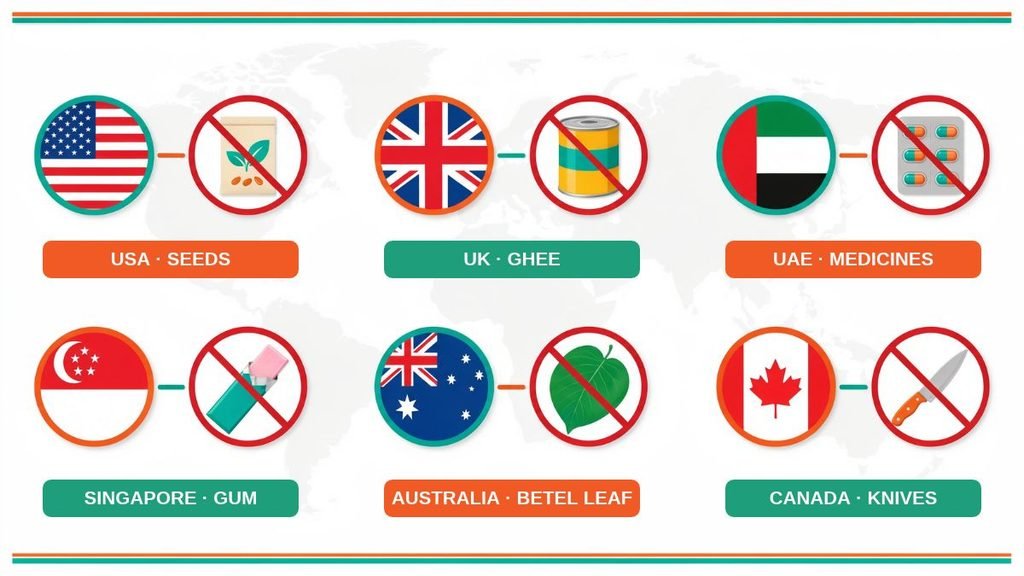
Which items does each country stop most often?
Each row links to that country’s own page, so you can check your item rather than take a courier’s word for it.
| Destination | India-origin items stopped most often | Official page |
|---|---|---|
| USA | Food sent without FDA prior notice where it applies; prescription medicines; raw spices and seeds | FDA prior notice of imported foods |
| UK | Personal imports of meat and dairy; controlled drugs; offensive weapons including decorative blades | gov.uk banned and restricted goods |
| Canada | Food, plants and seeds without the required documents; prescription drugs; currency | CBSA importing by mail |
| Australia | Seeds, fresh plant material and leaves; ghee, pickles and other foods with animal content; wooden and bone handicrafts | Department of Agriculture, mailing goods |
| UAE | Betel leaves and poppy seeds (strictly prohibited); medicines and cosmetics without prior approval; food products pending approval. Our Chennai to Dubai courier guide covers the route. | Abu Dhabi Customs restricted and prohibited goods |
| Singapore | Chewing gum (prohibited); chewing tobacco, gutkha and khaini; medicines without HSA authorisation | Singapore Customs controlled and prohibited goods |
What happens if customs finds a prohibited item in my parcel?
The Chennai Customs courier cell page sets out the screening. Every courier consignment, documents and cargo alike, is screened 100 percent by X-ray or other non-intrusive techniques. Physical examination of export gifts, samples and goods is limited to a maximum of 10 percent of consignments, or specific intelligence, and a consignment selected is examined in full. Courier exports are cleared under the Customs Act 1962 and the Courier Imports and Exports Regulations, and the categories of gift and sample consignments are defined by value and by the condition that the goods are not subject to any prohibition or restriction.
In practice, a prohibited or misdeclared item leads to one of four outcomes. The parcel is held while customs asks the courier for documents or an explanation. The item is seized and the parcel may be confiscated. The parcel is returned to origin, and the return freight is charged to the sender. Or a penalty is imposed under the Customs Act on top of confiscation. A wrong declaration is not a packing mistake; it is the thing that turns a held parcel into a seizure and a penalty. Describe the contents exactly, declare the true value, and never place one item inside another to hide it.
What should I check before booking?
- Name the item exactly. Not “gift” or “food” but “250 g dry kaju katli, commercially packed”.
- Tier it. Is the problem Indian export law, the carrier, or the destination?
- Have the documents the tier needs: ASI certificate, prescription, invoice, ingredient label.
- Read the destination’s own page from the six-country table, not a courier’s summary.
- Declare the true value and the true purpose.
- Put nothing inside anything else to get it through.
- Ask the courier to confirm acceptance in writing before you pack.
Frequently asked questions
What is the difference between prohibited and restricted items?
In Indian export policy, DGFT defines prohibited as not permitted to be exported and restricted as export permitted under a DGFT licence. Carriers use the same words to mean never carried and carried only by prior agreement. Destinations use them to mean cannot enter and can enter with a permit. Check which body is speaking.
Can I send homemade sweets abroad by courier?
Dry, commercially packed sweets with an ingredient label travel to most destinations once the carrier confirms acceptance. Home-made, moist or milk-based sweets are stopped by food safety and biosecurity rules at the destination, and the USA requires prior notice to the FDA for food offered for import outside its gift policy. Check the destination page first.
Can I send ayurvedic products abroad?
Labelled, commercially packed ayurvedic products with an English ingredient list can be booked once the carrier confirms acceptance; DHL notes a CDSCO export certificate may be required. The destination may classify the product as a food, a supplement or a drug and hold it accordingly. Unlabelled or home-prepared herbal preparations are routinely refused.
Can I send Indian currency by courier?
No. The RBI regulations permit a person to carry notes out of India up to Rs 25,000 and do not provide for sending them. India Post and DHL Express both list currency notes and cash as prohibited items. A bank transfer is the only route for money, and a courier that accepts cash is exposing you to seizure.
Can I send seeds or plants abroad from India?
Rarely. The Australian Department of Agriculture lists seeds for planting among items that should not be sent, the UK restricts plants and seeds without a certificate, and Canada screens plant material in the mail. Seeds that may be exported freely from India are still stopped on arrival. Only send what the destination page says is allowed.
What happens if customs finds a prohibited item in my parcel?
Chennai Customs screens every courier consignment by X-ray and physically examines a share of them. A prohibited or misdeclared item is held, seized or returned to origin at the sender’s cost, and a wrong declaration exposes the sender to a penalty under the Customs Act. Accurate description and true value are the protection.
How does Galaxy Couriers check items not allowed in international courier from India?
Tell us exactly what is in the parcel and where it is going. We sort it through the three tiers, tell you which documents the partner carrier will ask for, and give you a quote before anything is booked. Galaxy International Couriers has shipped from Mylapore, Chennai since 2015 and does not obtain licences, certificates or permits on a customer’s behalf; it tells you what is required so the parcel is never booked wrongly. For items not allowed in international courier from India, the honest answer before pickup is worth more than a fast booking.
[…] everything else, from power banks to religious weapons, see our hub on items not allowed in international courier from India and the GOV.UK page on banned and restricted goods. This article does not repeat those […]