
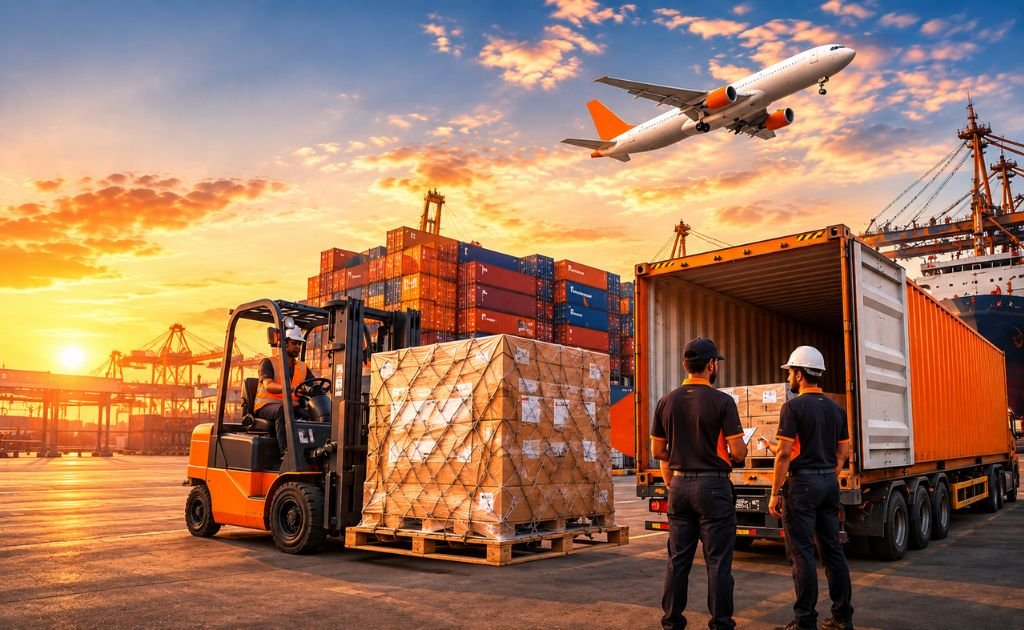

If your business imports or exports through Chennai, you already know that international shipping is never just “moving cargo from A to B.” A single commercial shipment can involve mode selection, freight booking, export packing, commercial documentation, customs coordination at both ends, origin and destination handling, tracking, and last-mile delivery – often across three or four different organisations in two different countries.
That is exactly why international freight forwarding companies in Chennai exist: to coordinate all of those moving parts on your behalf, so a delayed document or a mis-declared weight doesn’t turn into a stuck container or an unexpected invoice.
Choosing the right partner affects far more than the freight rate. It affects your landed cost, your delivery commitments to customers, your visibility while cargo is in transit, and how quickly problems get solved when something goes wrong. This guide explains what freight forwarders actually do, how air and sea freight differ, what really drives international freight cost from Chennai, which documents you’ll need, and how to evaluate a forwarding or cargo partner before you hand over your shipment.
Table of Contents
What Does an International Freight Forwarding Company in Chennai Do?
An international freight forwarding company in Chennai coordinates the movement of commercial cargo between India and overseas markets. Depending on the service scope, a forwarder may arrange air or sea transport, prepare and check shipping documentation, coordinate customs-related processes, consolidate smaller shipments, manage origin and destination handling, and organise final delivery. Not every forwarder performs every function in-house – many coordinate specialist partners for customs clearance, trucking, or overseas delivery.
Freight Forwarding, Explained in Plain Business Terms
Strip away the jargon and international freight involves a small cast of players:
- Shipper (consignor): the business sending the goods – for example, an exporter in Chennai.
- Consignee: the party receiving the goods at the destination.
- Carrier: the airline or shipping line that physically moves the cargo.
- Customs authorities: government agencies at origin and destination that control what crosses the border, and collect applicable duties and taxes.
- Freight forwarder: the coordinator in the middle. The forwarder doesn’t usually own the aircraft or vessel; it books space with carriers, manages documentation and handling, and keeps the shipment moving through each stage.
Think of a forwarder the way you’d think of a project manager for your shipment. Your team stays focused on the business; the forwarder manages the sequence of bookings, paperwork and handoffs between Chennai and the destination.
Freight Forwarder vs Courier Company: Which Does Your Business Need?
Many Chennai businesses start with this question, and the honest answer is: it depends on what you ship, how much of it, and how often.
| Factor | Freight Forwarder | International Courier |
| Typical shipment type | Palletised or containerised commercial cargo | Documents, parcels, cartons, smaller consignments |
| Commercial cargo | Core business | Handled, usually up to a few hundred kilograms |
| Larger consignments | FCL/LCL containers, large air freight | Less suited to container-scale volumes |
| Air/sea options | Both, chosen per shipment | Primarily air/express networks |
| Consolidation | Common (especially LCL) | Sometimes, for bulk parcel bookings |
| Documentation | Full commercial shipping documentation | Simplified paperwork for most parcels |
| Door-to-door | Available, depends on Incoterm and service | Standard offering |
| Best suited for | Regular importers/exporters moving volume | Samples, e-commerce orders, spares, urgent smaller cargo |
The two models also overlap. A courier and cargo company that works with international express networks can be the faster, simpler option for commercial shipments in the tens or low hundreds of kilograms – product samples, e-commerce parcels, urgent spare parts, exhibition materials. Galaxy Couriers sits in this overlap: it is an international courier and cargo services company in Chennai, with a particular focus on air cargo, door-to-door delivery and export packing, working with global networks such as DHL, FedEx, UPS and Aramex. For container-scale ocean freight programmes, a dedicated forwarder may be the better fit – and a good partner will tell you that honestly rather than force-fit your cargo.
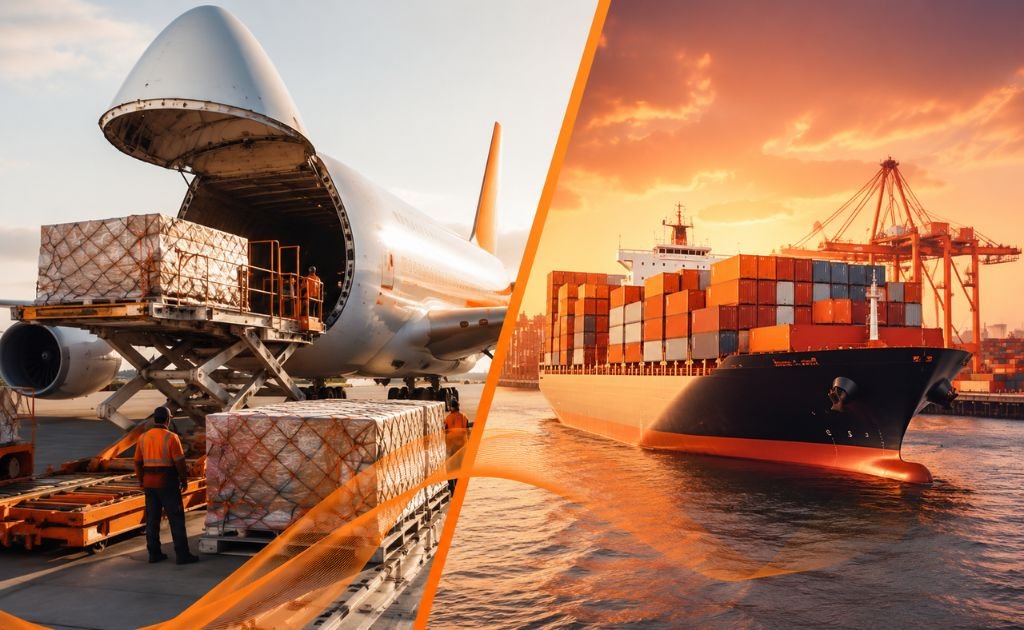
Air Freight vs Sea Freight: How Chennai Businesses Decide
| Factor | Air Freight | Sea Freight |
| Speed | Days, typically | Weeks, typically |
| Cost | Higher per kg | Often lower per unit for suitable volume |
| Cargo suitability | Time-sensitive, high-value, perishable, smaller | Bulk, heavy, oversized, non-urgent |
| Shipment size | Usually kilograms to a few tonnes | LCL cartons/pallets up to full containers |
| Best for | Urgent orders, samples, electronics, pharma, spares | Machinery, raw materials, large regular volumes |
| Planning | Shorter lead times possible | Needs earlier booking and schedule planning |
There is no universally “cheaper” or “better” mode. Air freight is usually chosen when speed, product value or shelf life matters more than the freight bill. Sea freight can be more economical for larger, heavier shipments that can absorb longer transit – but actual pricing always depends on the route, cargo characteristics, season and service level. Many Chennai businesses use both: sea for planned stock replenishment, air for urgent top-ups.
FCL vs LCL: Container Choices for Sea Freight
- FCL (Full Container Load): you book an entire container for your cargo alone. It suits larger volumes, gives you control over loading, and avoids sharing space with other shippers’ goods.
- LCL (Less than Container Load): your cargo shares a container with other shipments. A consolidator groups compatible cargo, and you pay broadly for the space you use.
LCL makes exporting viable for businesses that can’t fill a container; FCL generally becomes attractive as volumes grow, or when cargo shouldn’t be co-loaded. There’s no fixed cut-off – the right choice depends on your cargo’s volume, weight, packaging and the specific rates on your route, which is exactly the kind of comparison a quotation should show you.
How the International Freight Forwarding Process Works
Every shipment is different, but a well-run international freight movement from Chennai typically follows this sequence:
- Shipment assessment – cargo type, weight, dimensions, value, destination, urgency.
- Mode selection – air, sea, or a combination, based on cost and timeline.
- Quotation – a written quote setting out charges, inclusions and exclusions.
- Documentation – commercial invoice, packing list and other required paperwork prepared and checked.
- Pickup and origin handling – collection, export packing where needed, delivery to the airport or port.
- Consolidation or container planning – for LCL or grouped air cargo, where applicable.
- Customs-related coordination at origin – export formalities before the cargo leaves India.
- Main transport – the flight or sailing.
- Destination handling and import formalities – coordinated by the forwarder’s destination office or partner.
- Final delivery – to port/airport, or to the consignee’s door, depending on the agreed service.
- Tracking and document closure – proof of delivery and final paperwork.
Which stages apply – and who performs them – depends on your shipment type, the Incoterm agreed with your buyer or supplier, and the service scope you’ve purchased. Always confirm where your partner’s responsibility starts and ends.
Documents Commonly Required for International Freight

Documentation is where inexperienced shippers lose the most time. The commonly required documents include:
- Commercial invoice – the transaction record customs authorities assess.
- Packing list – what’s inside each package, with weights and dimensions.
- Air waybill (AWB) – the transport document for air freight.
- Bill of lading (B/L) – the transport document for sea freight.
- Certificate of origin – where required by the destination country or a trade agreement.
- Import/export registration – Indian businesses generally need an Importer-Exporter Code (IEC) issued through the DGFT to trade commercially.
- Commodity-specific paperwork – licences, declarations or certificates for regulated goods such as pharmaceuticals, food or chemicals.
Exact requirements vary by commodity, origin, destination and shipment type, and customs rules change – so treat this as orientation, not legal advice. A capable partner will tell you precisely what your shipment needs before it’s booked, and India’s customs framework is published by the Central Board of Indirect Taxes and Customs (CBIC) if you want the primary source.
What Actually Affects International Freight Cost from Chennai?
The single most common misunderstanding in B2B shipping: the quoted freight rate is not the total landed cost. Your final cost is shaped by:
- Route – origin, destination, and how well-served the trade lane is.
- Mode – air vs sea, express vs standard.
- Weight and volume – carriers charge on chargeable weight: the higher of actual weight and volumetric weight, so light-but-bulky cargo costs more than the scale suggests.
- FCL vs LCL – and container size, for sea freight.
- Cargo type – general cargo vs perishable, fragile, high-value or dangerous goods.
- Origin charges – pickup, packing, handling, terminal and documentation fees in Chennai.
- Destination charges – handling, delivery order fees, storage and last-mile delivery abroad.
- Customs duties and taxes – payable to governments, separate from freight, and dependent on the goods and destination.
- Surcharges – fuel and security surcharges that move with market conditions.
- Insurance – optional but sensible for high-value cargo.
- Incoterms – which determine how these costs split between buyer and seller.
Why Chennai Freight Pricing Is Quotation-Driven
Because so many variables move, credible providers don’t publish fixed international freight tariffs, which is also why international courier charges from Chennai are quoted shipment by shipment rather than listed as a flat rate. To get a fast, accurate quote, share: origin and destination (city/port), cargo description, gross weight, dimensions or volume, number of packages, preferred mode, whether you need pickup and packing, whether you need door delivery or airport/port delivery, and the applicable Incoterm if agreed.
Then judge the quote on transparency, not just the headline number. A professional quotation states what’s included, what’s excluded, and which charges are estimates. If destination charges, duties or surcharges aren’t mentioned at all, ask why – before you book, not after.
Shipping commercial cargo from Chennai soon?
with your cargo details – weight, dimensions, destination and timeline – for a clear, no-obligation quote.
A Quick Word on Incoterms
Incoterms are standardised trade terms, published by the International Chamber of Commerce, that define who – buyer or seller – arranges and pays for each leg of the journey, and where risk transfers. The difference between selling EXW (buyer handles almost everything from your factory gate) and DAP (seller delivers to the buyer’s named place) is enormous in cost and responsibility. Before quoting a price to an overseas customer or accepting a supplier’s terms, confirm the Incoterm and have it reviewed by a qualified trade or logistics professional – it decides who pays for most of the cost items listed above.
Chennai as an International Freight Hub
Chennai gives local businesses a genuine logistics advantage: multiple international gateways within a short drive of the city’s industrial base.
- Chennai Port, one of India’s oldest major ports on the Coromandel coast, handles containerised cargo on the city’s doorstep.
- Kamarajar Port at Ennore, north of the city, adds further cargo capacity for the region.
- Chennai International Airport connects the city’s air cargo to major global destinations – critical for time-sensitive exports like electronics, garments, and pharmaceuticals, as well as urgent imports of components and spares.
Around these gateways sits one of India’s densest manufacturing belts – automotive and auto components, engineering, electronics and hardware, leather, textiles and garments, and pharmaceuticals – plus a fast-growing e-commerce export community. For a Chennai-based importer or exporter, working with a partner who operates in this ecosystem daily means realistic transit expectations and fewer surprises at the gateway.
Industries That Typically Need Freight Forwarding and International Cargo Services
- Automotive and engineering – components and machinery moving to and from global supply chains.
- Electronics – high-value, time-sensitive cargo where air freight often wins.
- Textiles and garments – export cartons ranging from LCL sea shipments to urgent air consignments.
- Pharmaceuticals and medicines – strict documentation and time-and-temperature sensitivity.
- E-commerce and D2C brands – frequent smaller international shipments where courier-style door-to-door service shines.
- Traders and importers – sample shipments, first orders and stock replenishment.
If your volumes are container-scale, prioritise partners with deep ocean-freight capability. If your shipments are urgent, smaller, or door-to-door – samples, online orders, spares, exhibition cargo – an air-cargo-focused overseas courier partner is often faster and simpler.
How to Choose an International Freight or Cargo Partner in Chennai
Use this checklist before committing your cargo:
- Coverage – do they actually serve your destination countries, not just “220+ countries” on a banner?
- Mode options – can they compare air and sea honestly for your cargo?
- Documentation support – will they check your invoice and packing list before cargo moves?
- Customs coordination – who handles export and import formalities, and is that in scope?
- Tracking and visibility – how will you know where your shipment is?
- Packing capability – export-grade packing matters more than most first-time shippers expect.
- Quotation transparency – inclusions, exclusions and estimates clearly separated.
- Insurance options – available and explained for high-value cargo.
- Communication – a named person who answers, especially when something goes wrong.
- Relevant experience – with your cargo type and your trade lane, ideally with references.
12 Questions to Ask Before You Book
- Which transport modes and service levels do you offer for my route?
- Which destinations do you handle regularly, and through which partners?
- What exactly is included in your quotation?
- Which charges are excluded or estimated – destination charges, duties, storage?
- How do you calculate chargeable weight for my cargo?
- Do you handle FCL and LCL, and which do you recommend for my volume?
- How is customs coordination handled at origin and destination?
- How will I track the shipment, and how often will I get updates?
- What happens if the shipment is delayed or held – who do I call?
- Do you offer cargo insurance, and what does it cover?
- Who performs the final delivery at destination?
- Can you share references or examples from my industry?
Red Flags to Avoid
Walk away from providers who give vague one-line quotations, can’t explain exclusions, promise unrealistic transit times, offer no tracking or shipment visibility, have no clear documentation process, can’t tell you what cargo they won’t carry, or have no escalation contact when a shipment is stuck. In international freight, opacity at the quoting stage almost always becomes cost at the delivery stage.
Where Galaxy Couriers Fits In
Galaxy Couriers (Galaxy International Couriers) is a Chennai-based international courier and cargo services company, founded in 2015 and operating from two locations in Mylapore. Its founder’s background is in air cargo handling, and the company’s core strengths reflect that:
- International shipping to major destinations across the USA, Europe, the Middle East, Australia and Asia, working with global networks including DHL, FedEx, UPS and Aramex.
- Specialised air cargo handling for larger and time-sensitive shipments, alongside everyday parcels and documents.
- International cargo services covering both air freight and sea shipment options, including FCL and LCL, with documentation and customs-related support as described on its international cargo services page.
- Door-to-door service with free doorstep pickup across Chennai.
- Complimentary export packing using professional materials – valuable for fragile items and commercial goods.
- Real-time tracking on international shipments, and a 4.9-star Google rating from customers.
Galaxy Couriers doesn’t position itself as a container shipping line or a large multinational forwarder – and that’s the point. For Chennai businesses shipping commercial cargo, e-commerce orders, samples, spare parts or urgent air consignments abroad, it offers something many large forwarders don’t: a local, responsive team that picks up from your door, packs professionally, and manages the shipment through trusted global networks.
Ready to move your shipment?
or call +91 99412 89341 with your cargo details, and the team will recommend the right service and give you a transparent price.
Frequently Asked Questions
What is an international freight forwarding company?
It’s a company that coordinates international cargo movement on behalf of shippers – arranging transport with airlines or shipping lines, managing documentation, coordinating customs-related processes, and organising handling and delivery. Forwarders act as coordinators rather than owning the vessels or aircraft.
How do I choose a freight forwarder in Chennai?
Shortlist providers that serve your destination and cargo type, then compare quotation transparency, documentation support, customs coordination, tracking, and responsiveness. Ask the twelve questions listed above and insist on written inclusions and exclusions.
What is the difference between freight forwarding and courier service?
Freight forwarding typically handles larger palletised or containerised commercial cargo across air and sea, with full commercial documentation. Courier services move documents, parcels and smaller consignments – usually door-to-door by air – with simpler paperwork and faster booking. Many commercial shipments under a few hundred kilograms are well served by an international courier and cargo company.
What is the difference between air freight and sea freight?
Air freight is faster and suits urgent, high-value or perishable cargo, but costs more per kilogram. Sea freight takes longer and suits larger, heavier shipments where per-unit cost matters more than speed. The right choice depends on your route, cargo and deadline.
What are FCL and LCL?
FCL (Full Container Load) means your cargo fills its own container. LCL (Less than Container Load) means your cargo shares a container with other shippers’ goods and you pay broadly for the space used. LCL suits smaller sea shipments; FCL suits larger volumes.
How much does international freight forwarding cost from Chennai?
There is no fixed tariff – cost depends on route, mode, chargeable weight, cargo type, origin and destination charges, surcharges, duties and insurance. Share your cargo details (weight, dimensions, destination, timeline) to get an accurate quotation, and always check what the quote includes and excludes.
What documents are needed for international shipping from India?
Most commercial shipments need a commercial invoice and packing list, plus an air waybill or bill of lading. Many need a certificate of origin, and Indian businesses generally need an IEC (Importer-Exporter Code). Requirements vary by commodity and destination – confirm before booking.
Does a freight forwarder handle customs clearance?
Often it coordinates customs-related processes, either in-house or through licensed customs partners – but scope varies by provider and service. Always confirm in writing whether export and import formalities are included in your quotation.
Can I get door-to-door delivery for international cargo from Chennai?
Yes. Door-to-door service – pickup at your premises in Chennai through to delivery at the consignee’s address abroad – is standard for courier shipments and available for many cargo services, depending on the destination and agreed terms.
How is chargeable weight calculated?
Carriers charge on the higher of actual weight and volumetric weight (calculated from your package dimensions). Bulky but light shipments are charged on volume, which is why accurate dimensions are essential for a correct quote.
How long does international shipping from Chennai take?
Express courier and air cargo shipments typically move in days; sea freight typically takes weeks. Exact transit depends on the destination, routing, customs processing and service level – ask for a realistic estimate for your specific lane rather than relying on generic promises.
Does Galaxy Couriers handle commercial cargo and international shipments from Chennai?
Yes. Galaxy Couriers provides international courier and cargo services from Chennai, including specialised air cargo handling, door-to-door delivery, complimentary export packing, tracking, and shipping to major destinations worldwide through partners such as DHL, FedEx, UPS and Aramex. Contact the team with your shipment details for a quote.