
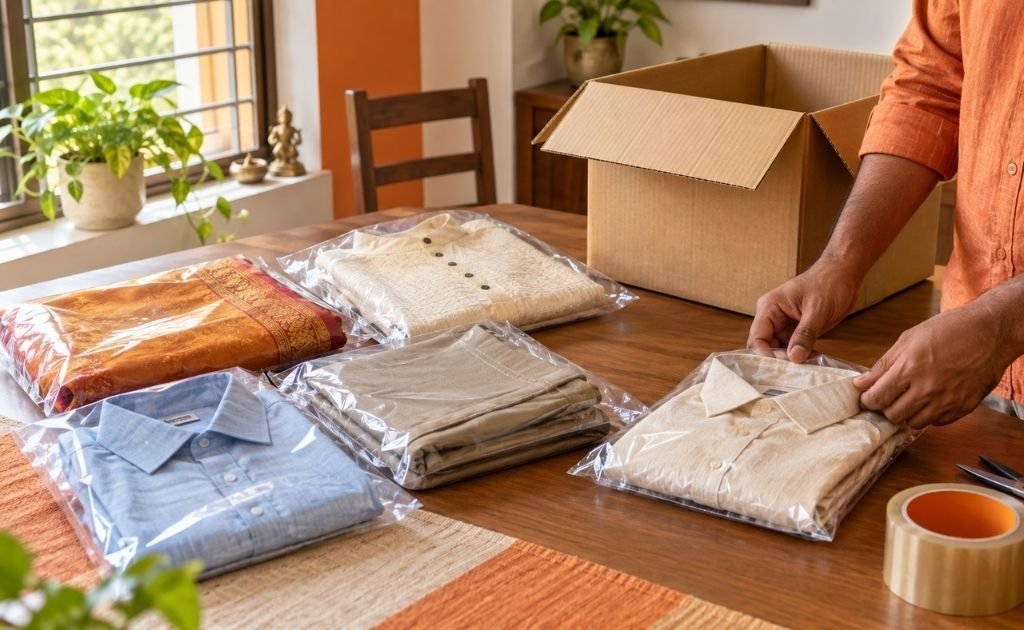

Sending two shirts to a cousin in Bengaluru takes ten minutes and a poly bag. Sending a silk kurta set, a winter jacket, a boutique order and a few children’s dresses to a relative in Toronto is a different job: the packaging, parcel size, chargeable weight and customs description all change.
So the plain answer first: there is no single best way to courier clothes that suits every parcel. The right approach depends on the type of clothes, the quantity, the destination, the value and whether the shipment is domestic or international. This guide follows those decisions in the order a courier professional makes them, with practical notes for anyone sending clothes from Chennai.
Table of Contents
What Is the Best Way to Courier Clothes? (Quick Answer)
- Make sure every garment is clean and completely dry.
- Fold each piece neatly so it sits flat.
- Protect individual items where it helps, especially delicate or light-coloured pieces.
- Add an inner moisture and dust barrier, such as a clean polythene liner, inside the outer packaging.
- Choose the outer packaging (poly mailer, padded mailer or carton) based on quantity and garment type.
- Fill gaps so the clothes cannot slide around, without stuffing the box.
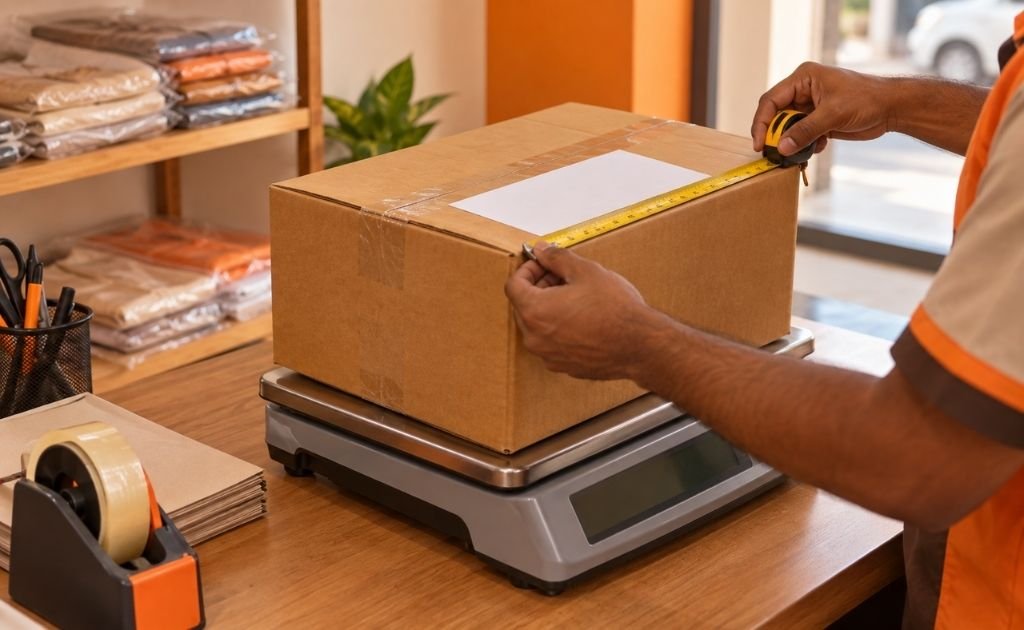
- Measure and weigh the parcel after it is fully packed and sealed.
- Give accurate sender and receiver details, including a working phone number for the receiver.
- For international parcels, describe the contents accurately and check the destination’s requirements.
- Choose a courier on destination coverage, urgency, tracking, packing support and the actual quote.
No packaging format is the cheapest or safest for every shipment. A poly mailer suits three T-shirts and is a poor choice for a beaded lehenga.
How to Pack Clothes for Courier: Step by Step
Step 1: Sort the clothes
Separate the garments into everyday cotton and synthetic pieces, delicate fabrics (silk, chiffon, fine handloom), embellished garments (zari, embroidery, beads, sequins), high-value pieces, and any shoes or accessories travelling in the same parcel. The aim is simply to see which items need extra protection.
Step 2: Clean and dry everything
Never pack damp clothing. Moist fabric sealed in plastic can develop odour or marks over a multi-day journey, and international parcels can spend a week or more in transit and customs. Chennai’s humidity makes this worth taking seriously: air-dry garments fully indoors before packing. It is a precaution, not a worry; dry, well-wrapped clothes travel fine.
Step 3: Fold neatly
Fold shirts and kurtas in thirds with sleeves tucked back, trousers along the crease, and dresses so the bodice is not crushed. Folding gives a flat stack that uses a box efficiently. Rolling works for casual T-shirts and children’s clothes when space is tight, but rolled bundles stack less cleanly. Use whichever gives a compact, even stack.
Step 4: Protect individual items
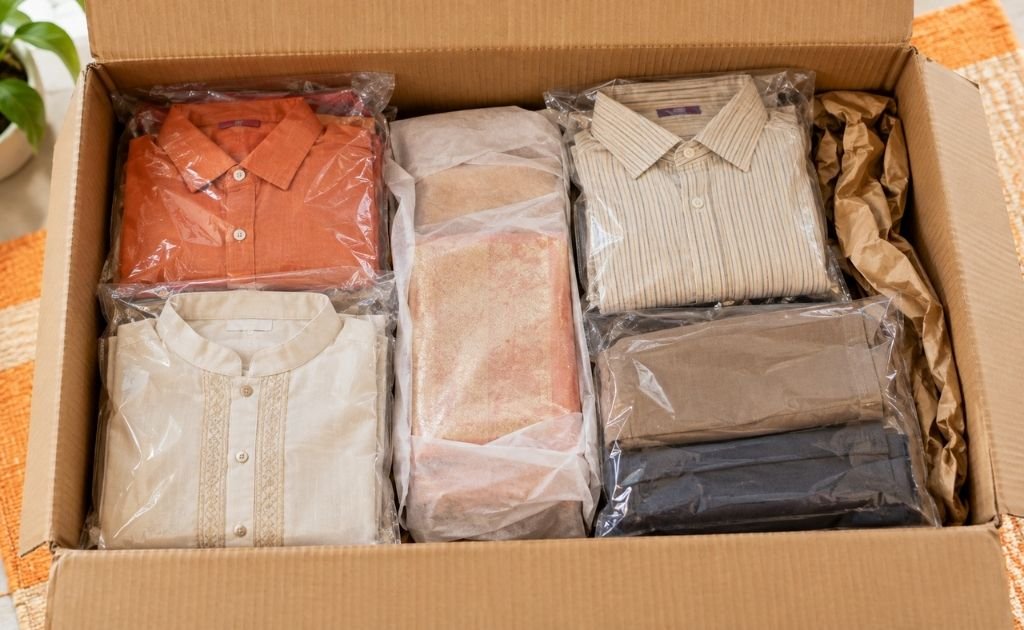
For multi-piece parcels, put garments in separate clean polythene or cloth bags when it helps with cleanliness, moisture, colour transfer between dark and light fabrics, or keeping outfits organised for the receiver. Not every shirt needs bubble wrap; bag in sensible groups and save heavier protection for delicate pieces.
Step 5: Protect delicate and embellished clothing
Silk, zari, embroidery, beads and sequins need a soft layer between them and anything rough. Wrap these in tissue paper or clean cotton cloth, bag them individually and place them in the centre of the box. If you are sending sarees, especially Kanchipuram silk or bridal pieces, our guide to saree courier service in Chennai goes deeper into fold techniques and zari protection.
Step 6: Choose the outer packaging
Match packaging to the shipment: quantity, garment value, destination, the shape of the stack and how vulnerable the items are to crushing or moisture. The table below sets out the options.
Step 7: Fill excess space
Clothes that shift inside an oversized box crease badly and, in mixed parcels, rub against harder items. Use a box close to the size of the packed stack and fill any gap with crumpled paper. Do not compress clothes to force a smaller box.
Step 8: Seal the parcel properly
Run strong packing tape across every opening seam, including the bottom of the carton. Leave one flat face clear for the shipping label and, for international parcels, the documents pouch. Write the receiver’s name and phone number on a slip inside the box in case the outer label is damaged.
Which Packaging Should You Use for Clothes?
| Packaging | Best suited for | Main consideration |
| Poly mailer | Small, non-fragile parcels: a few T-shirts, cotton kurtas, children’s clothes | Little protection against crushing |
| Padded mailer | Small parcels needing more protection: a silk top, a lightly embellished dupatta | Limited space |
| Corrugated box | Multiple garments, mixed outfits, longer domestic or international journeys | Larger dimensions raise volumetric weight |
| Double-wall / stronger box | High-value, heavy or bulky shipments: winter wear, wedding trousseau, boutique consignments | Adds weight and size |
How to Courier Different Types of Clothes
Cotton clothes. Shirts, kurtas and trousers are the easiest garments to send. Fold, bag, box. The only rule that matters is clean and dry.
Silk and delicate garments. Silk creases sharply and shows water marks. Fold with tissue between layers, bag individually and keep it central in the parcel. Avoid vacuum-compression bags for silk.
Embroidered and embellished clothes. Turn heavily decorated garments inside out or wrap the decorated face in tissue so beads and zari do not snag on other items.
Winter clothing. Jackets, sweaters and shawls are light but bulky, which pushes up volumetric weight. Fold tightly, use a garment bag rather than bubble wrap, and consider two compact boxes instead of one large one.
Children’s clothes. Easy to pack. Group by child or outfit in separate bags and check pockets before sealing.
Designer and high-value clothing. Use a sturdy box, protect each piece individually, and ask the courier about declared-value or coverage options before booking. Do not assume coverage is automatic; terms differ between couriers.
How Many Clothes Can Go in One Courier Parcel?
There is no fixed number. Capacity depends on garment thickness, folding method, outer packaging, weight, box dimensions, destination and the courier’s limits for the chosen service. Three padded jackets can fill a box that holds fifteen folded cotton shirts, and two efficient boxes often cost less than one oversized, half-empty carton.
Best Way to Courier Clothes Within India
Domestic clothing parcels range from a student’s winter clothes going to Delhi to daily boutique orders leaving Chennai for customers across the country. Focus on:
- Packaging: a poly mailer or small carton is usually enough for personal parcels; boutique orders benefit from a branded bag inside a mailer.
- Pickup: doorstep pickup is worth asking about, especially for regular senders.
- Weight and dimensions: measure after packing so the quote holds.
- Service level: surface and air options exist on many routes; choose by when the receiver needs the clothes.
- Tracking: insist on a tracking number and share it with the receiver.
Transit times vary by route and service, so confirm them for your destination rather than relying on a general figure.
Clothes Courier from Chennai: Two Local Notes
Clothes leave Chennai every day for Bengaluru, Hyderabad, Mumbai, Delhi, Coimbatore, Madurai and abroad, and the packing advice above applies on every route. Two local points: give garments extra drying time and use an inner liner even for short hops, because the city stays humid most of the year; and if the parcel is for a wedding, a festival or a university start date, book with a margin, particularly on international routes where customs adds time.
International Clothes Courier: Sending Clothes Abroad from India
This is where preparation matters most. Sending clothes to the USA, UK, Canada, Australia, Singapore, Malaysia or the Gulf involves the same three stages.
Before shipping
Confirm the destination country, the type and number of garments, whether the shipment is personal or commercial, the packed dimensions and weight, and the value of the contents. Value and purpose determine how the parcel is treated on arrival.
During booking
Provide an accurate item description (for example, “3 cotton shirts, 2 silk kurtas, 1 child’s dress” rather than “clothes” or “gift”), full sender and receiver details with phone numbers, and any documents the destination requires. If you would rather have an overseas parcel packed professionally, Galaxy’s international packing services in Chennai cover moisture-proof wrapping and export-grade cartons.
During transit
Track the parcel, expect customs processing at the destination, and be aware that the receiver may have to pay duties or taxes depending on the country, the declared value and whether the shipment is a personal gift or a commercial order.
In India, courier exports and imports are handled under dedicated courier regulations, and only couriers registered with Customs as “Authorised Couriers” can use the courier clearance facility. Chennai Customs explains the framework, including value thresholds for bona fide gifts and samples, on its courier cell procedure page. Clearance is never automatic; parcels are screened and may be examined.
One destination-specific point: the United States ended duty-free “de minimis” treatment for most low-value parcels in August 2025, so clothing sent to the USA may now attract duties that previously did not apply. Confirm the current position for your parcel before booking.
Customs Declaration for Clothes: Describe Accurately
Vague descriptions are the most common cause of avoidable delays. Avoid “items”, “gift”, “personal stuff” or “used clothes” on their own. Describe the contents in enough detail for an officer to assess the shipment without opening it: garment type, material, quantity and a realistic value per item.
What the destination requires depends on the country, whether the goods are new or used, personal or commercial, the quantity and the declared value. Do not guess at tariff codes; your courier will tell you if an HS code is needed for the route.
Personal Clothes vs Business Clothing Shipments
| Shipment type | Typical treatment | What to be careful about |
| Your own clothes (relocation, student, forgotten luggage) | Personal shipment | Used clothing still needs an accurate description and value |
| Clothes sent as a gift to family | Personal shipment | Gift status does not remove destination rules; gift value limits vary by country |
| Clothing orders from a boutique or online store | Commercial shipment | Commercial invoice, business details and possibly HS codes are expected |
| Samples sent to a buyer | Often commercial; sometimes treated differently | Describe as samples and check the destination’s rules first |
Customs treatment differs by country, so use this table to frame the conversation with your courier, not as a rule book.
How Much Does It Cost to Courier Clothes?
Any page that quotes a single “clothes courier cost per kg” is guessing. A clothing parcel quote is built from actual weight, volumetric weight, parcel dimensions, number of pieces or boxes, destination, domestic or international routing, service level, pickup, packaging supplied by the courier, declared-value or coverage options where offered, and duties or taxes at the destination for international parcels.
A simple comparison shows why: ten lightweight T-shirts folded tightly into a compact carton are light and small. Three bulky jackets in a large box weigh little but occupy far more space, and the courier charges on that space. The jackets can cost more to send than the T-shirts despite being fewer items.
Actual Weight vs Volumetric Weight for Clothing Parcels
Couriers charge on whichever is higher: the parcel’s actual weight on the scale, or its volumetric weight, a figure derived from the box’s length, width and height. A large box of lightweight clothes can therefore be billed at a chargeable weight well above what it weighs.
The divisor used to convert dimensions into kilograms varies between couriers and services, so ask which method applies to your route and check it on the quote. The takeaway for clothing is simple: pack tightly, use the smallest sturdy box that fits, and measure after sealing. If you are sending a mixed parcel of clothes and handmade or decorative items, our handicraft courier service in Chennai guide has a worked example of how box size changes the chargeable weight.
How Long Does a Clothes Courier Take?
Delivery time depends on origin, destination, service level, pickup timing, public holidays, operational conditions and, for international parcels, customs processing. Transit time should be confirmed for the specific route and service when you book.
How to Choose the Best Clothes Courier Service
Compare couriers on what affects a clothing parcel, not just the headline price: destination coverage, packing support, tracking that both you and the receiver can use, doorstep pickup, willingness to guide you on descriptions and documents, responsiveness before booking, their coverage or claims terms for loss or damage, service levels on your route, the written quote for your packed parcel, and experience handling garments and textiles. The lowest quote is not always the right choice, particularly for silk or designer wear.
Common Clothes Shipping Mistakes
- Packing clothes that are not fully dry
- Using a box much larger than the packed stack
- Leaving clothing loose inside the box with no inner bag
- Using a weak mailer for a heavy multi-piece parcel
- Placing embellished garments against rough surfaces or hard items
- Measuring and weighing before final packing instead of after
- Writing a vague or inaccurate shipment description
- Ignoring destination requirements for used or commercial clothing
- Booking international parcels at the last minute
- Assuming personal and commercial shipments are treated the same way
Sending Clothes from Chennai with Galaxy International Couriers
If you are sending clothes from Chennai and are unsure about packaging, destination requirements or the most suitable shipping option, Galaxy International Couriers can talk through the parcel details with you before booking. Galaxy has offered domestic and international courier services from Mylapore since 2015, with packing support, doorstep pickup and shipment tracking, and works with major international carrier networks for overseas deliveries. Bring the packed parcel, or ask about packing on site, and get a courier quote based on the actual weight, dimensions and destination.
FAQs: Couriering Clothes
What is the best way to courier clothes?
Clean and dry the garments, fold them flat, bag delicate or light-coloured items separately, use a snug mailer or carton with an inner moisture barrier, seal every seam, measure and weigh after packing, and book with a courier that covers your destination and offers tracking. The method changes with garment type, quantity and destination.
How should clothes be packed for courier?
Fold each item, place garments in clean inner bags, put delicate pieces in the centre of the box, fill gaps lightly and tape every seam. Use a poly mailer for a few cotton items and a corrugated box for multiple or valuable pieces.
Can I send clothes by courier from Chennai to other countries?
Yes. Clothes are regularly sent from Chennai to the USA, UK, Canada, Australia, Singapore and the Gulf. The parcel must be described accurately, and the receiver may be liable for duties or taxes depending on the destination and declared value.
How much does it cost to courier clothes?
It depends on actual weight, volumetric weight, dimensions, destination, service level and options such as pickup or coverage. Ask for a quote on the packed parcel rather than relying on a per-kg figure.
Does a courier charge clothes by actual or volumetric weight?
Whichever is higher. Bulky, lightweight items such as jackets are often charged on volumetric weight, which is why packing tightly in a small box matters.
Can I courier silk, designer or expensive clothes?
Yes, with extra care: tissue between folds, an individual bag, a central position in a sturdy box, and a conversation with the courier about declared-value or coverage options before booking.
Can I send clothes as a gift abroad?
Yes. Describe the contents accurately even when they are a gift, and remember that gift allowances differ by country and do not remove the need for a proper declaration.
How long does a clothes courier take?
It varies with route, service level and customs. Confirm the transit time for your destination when booking, and allow extra time for international parcels needed by a fixed date.