
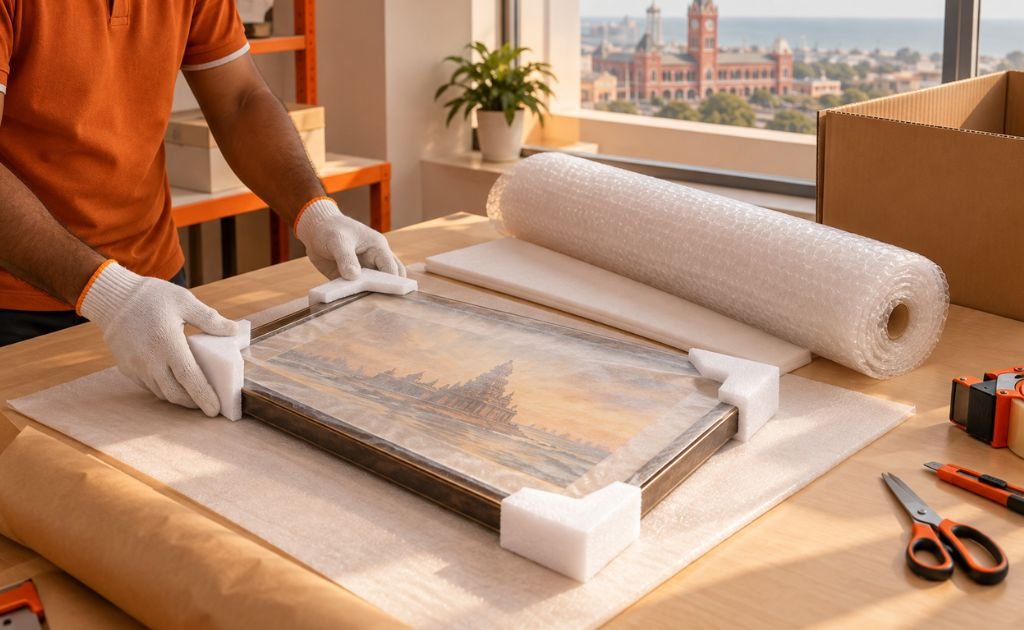

Artwork needs different handling from an ordinary parcel because it is usually fragile, often valuable, frequently oversized and easily damaged by the very things a parcel network does routinely: stacking, vibration, humidity and repeated handling. A fine art courier service exists to close that gap, with packing built around the piece, documentation that reflects its value, and a route planned for its destination.
This guide is written for anyone who has to move a painting, framed print, photograph, sculpture or collectible artwork from Chennai – an artist sending a commission, a collector relocating, a gallery dispatching work to a show, an online seller fulfilling an order, or a family sending a traditional painting to a relative abroad. It covers what a fine art courier actually does, how artwork should be packed, when a crate is worth it, how declared value differs from insurance, which customs and cultural-property rules to check, what drives the cost, and how to choose a provider.
Table of Contents
What Is a Fine Art Courier Service?
A fine art courier service (sometimes written “fine arts courier” or simply art courier service) moves original artwork and collectible pieces with packing, documentation and handling matched to the item rather than to a standard parcel size. It sits between two more familiar services:
- Standard courier: parcels are expected to survive normal sorting, stacking and conveyor handling. Artwork usually is not built for that.
- Fragile courier: breakable items get extra cushioning, “fragile” handling flags and, in some cases, double boxing. This is a good fit for many framed prints and small pieces.
- Fine art courier: the packing, crate decision, valuation, customs description and delivery plan are all built around the specific artwork, its surface, frame, dimensions and value.
Standard fragile courier vs fine art courier
| Standard Fragile Courier | Fine Art Courier |
| General fragile items (glass, ceramics, electronics) | Artwork-specific handling |
| Generic cushioning and boxes | Packing tailored to surface, frame, corners and dimensions |
| Standard parcel sizes | Oversized or unusual dimensions may need custom boxes or crates |
| Basic protection | Surface, frame, glazing and corner-specific protection |
| Ordinary parcel documentation | Valuation, customs description and, where relevant, cultural-property checks |
| General handling | Fewer touch points and closer attention at each handover |
Not every artwork needs the full fine-art treatment. A small unframed print can travel perfectly well as a fragile parcel. A large framed oil, a glazed Tanjore painting or a bronze sculpture usually cannot.
Why Artwork Needs Different Handling from an Ordinary Parcel
The failure points for artwork are specific and predictable:
- Surfaces: oil, acrylic and gouache surfaces scuff, crack or pick up impressions from anything pressed against them. Pastel and charcoal smudge.
- Corners and edges: the first thing to hit the ground in a drop, and the most common damage on framed work.
- Frames and glazing: glass breaks and can slice the artwork behind it; ornate or gilded frames chip.
- Stretched canvas: a puncture from the back or a dent from the front is easy to cause and hard to repair.
- Movement inside the box: a piece that can shift even a centimetre will rub, and rubbing over a long transit does real damage.
- Moisture: humidity in transit and at destination affects paper, canvas and wooden panels.
- Weight and size: large or heavy pieces stress the base of a carton and are more likely to be laid flat or stacked.
- Value: the cost of a mistake is disproportionate, which is why documentation and coverage matter as much as packing.
What Kinds of Artwork Can Be Couriered?
Most artwork can be shipped domestically and internationally when it is packed correctly and described accurately. The method depends on the type.
Paintings and canvas works
Stretched canvases, panel paintings and mixed-media works travel best flat, face protected, with rigid boards on both sides. Large canvases can sometimes be removed from their stretchers and rolled in a tube for international transport, but only if the paint layer is stable and the recipient can re-stretch it professionally; thick impasto and older works should not be rolled.
Prints, photographs and works on paper
Unframed prints and photographs ship well between rigid boards in a flat mailer or, for larger sheets, rolled in a heavy-duty tube. Framed pieces need the glazing addressed first: acrylic glazing is far safer for shipping than glass, and glass that must travel should be taped in a grid pattern so that, if it breaks, the fragments stay in place rather than cutting the print.
Sculptures and three-dimensional pieces
Bronze and brass pieces are robust but heavy, so the risk is carton failure and impact chipping. Stone and marble chip at edges. Ceramic and mixed-material pieces are the most vulnerable and usually need custom-cut foam inserts, and often a crate. Protruding elements should be supported so they never bear load.
Traditional Indian art, including Tanjore paintings
Tanjore (Thanjavur) paintings combine a wooden board, gesso relief, gold foil and, very often, a glazed frame. They need surface protection that does not press on the relief, corner protection for the frame, glass taping and a rigid sandwich. Families and sellers regularly send these from Chennai to the USA, UK and Gulf countries. If you are shipping them as a handicraft business, the documentation and HS-code guidance in Galaxy’s handicraft courier service guide applies alongside the packing advice below.
Two caveats apply to every category. Anything that might be an antique, and any piece containing wildlife-derived or restricted natural materials, needs the checks described later in this guide before it is booked.
How to Pack Artwork for Courier Shipping
There is no single packing method for all artwork. There is, however, a consistent hierarchy of protection to work through for each piece.
The protection hierarchy
| Layer | What it protects | Typical materials |
| Surface | The paint, print or photographic layer | Glassine or acid-free tissue, then a clean plastic film barrier |
| Corners and edges | The most impact-prone points on frames and stretchers | Foam or cardboard corner protectors |
| Frame and glazing | Glass, acrylic and frame mouldings | Grid-taped glass, foam strips along the frame |
| Rigid support | Prevents flexing and punctures | Foam board, corrugated board or plywood on both faces |
| Cushioning | Absorbs shock | Bubble wrap or foam sheeting around the sandwich |
| Outer box | Structural protection and handling surface | Double-wall carton, sized with 5–8 cm clearance on every side |
| Crate | Oversized, glazed, heavy or high-value pieces | Timber crate with internal bracing (see the next section) |
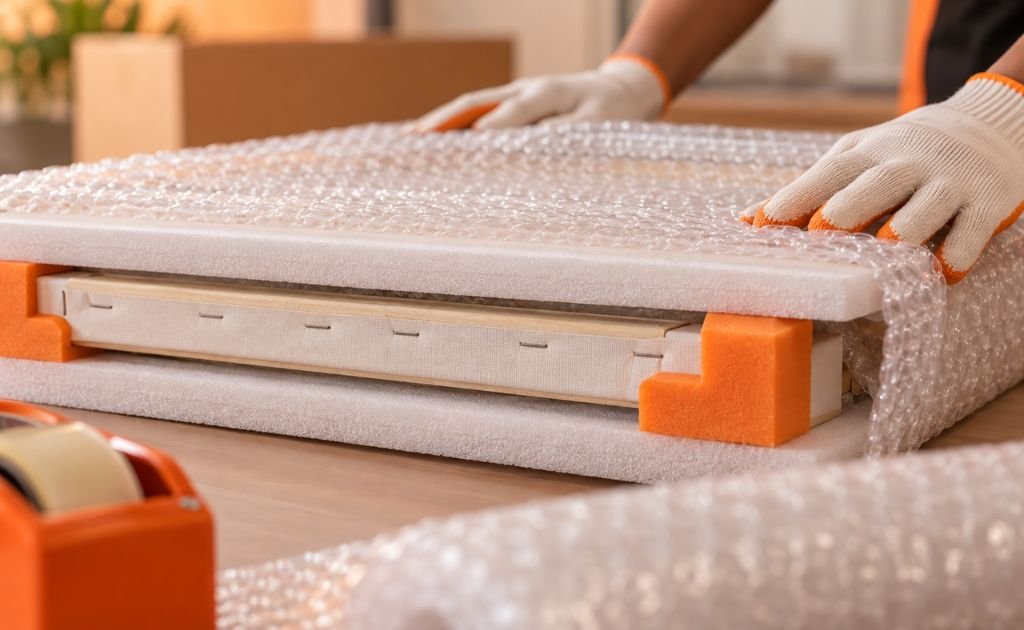
Step-by-step packing process
- Inspect and photograph the artwork. Take clear photos of the front, back, corners, frame and any existing marks before you wrap anything. Keep them with your booking details.
- Protect the surface. Cover the face with glassine or acid-free tissue. Never let bubble wrap or tape touch a painted surface directly. For works on paper under glass, tape the glass in a grid with low-tack tape.
- Fit corner protectors to every corner of the frame or stretcher.
- Add rigid boards on the front and back so the piece cannot flex. For a stretched canvas, the back board also prevents punctures.
- Wrap the sandwich in a moisture barrier, then in cushioning. Aim for even thickness on all sides.
- Choose an outer box that leaves room for cushioning without allowing movement. Fill voids so the piece cannot shift. For higher-value pieces, place the packed piece inside a second, larger carton with cushioning between the two (double boxing).
- Decide whether a crate is needed using the checklist in the next section.
- Seal and label the box with orientation and fragile markings, keep it upright where possible, and mark “this side up” for glazed pieces.
- Measure and weigh the finished package. Length, width, height and weight determine the courier price, so measure after packing, not before.
- Prepare documentation. An accurate description (medium, dimensions, artist, year), a value that you can support, and the recipient’s full details. International shipments need more; see below.
Ask your courier what they will pack for you and what they expect you to prepare. Galaxy Couriers packs shipments at pickup in Chennai, and for artwork it is worth agreeing the packing plan before the collection day rather than on the doorstep.
When Should Artwork Be Crated?
A crate is not automatically necessary, and for a small unframed print it adds cost and volumetric weight for no benefit. A crate is usually the right call when one or more of these apply:
- The piece is large – as a working rule, anything much beyond 90 cm on its longest side becomes hard to protect with a carton alone.
- It is framed with glass and travelling internationally or by air cargo.
- It is heavy (stone, bronze, thick panels) so a carton base may fail.
- It is high-value relative to the cost of the crate.
- It is a sculpture with protrusions or a fragile mixed-material piece.
- It will pass through multiple handling stages (courier to airline to destination agent) or is going to an exhibition where a reusable crate helps for the return journey.
- Several works are travelling together and need internal slots.
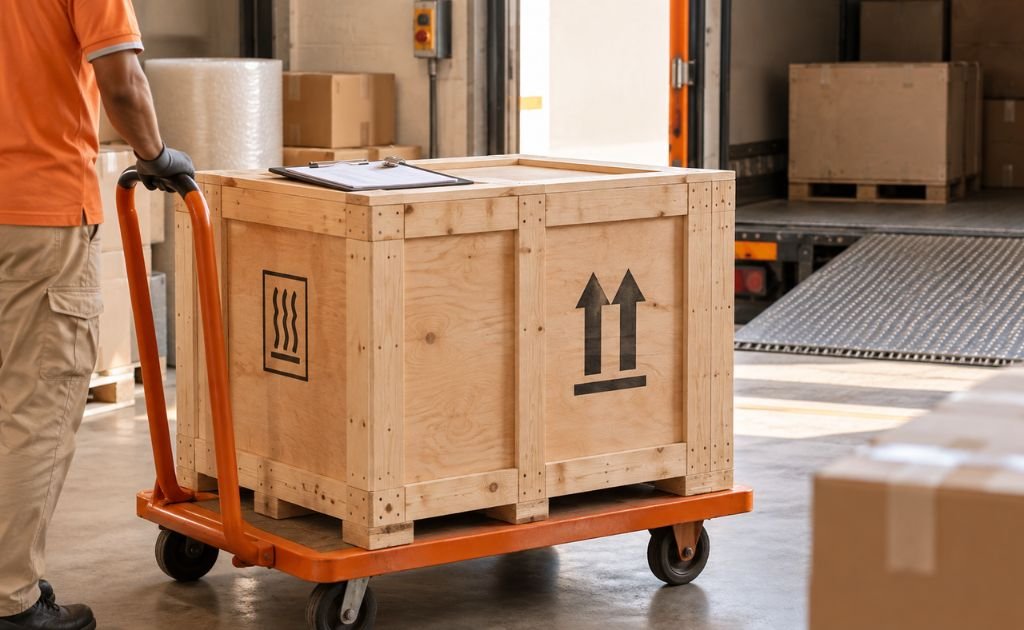
For international shipments, wooden crates must comply with the ISPM 15 standard for wood packaging, which requires treated and marked timber so the crate is not refused or destroyed at the border. Ask for the treatment mark before dispatch. Galaxy’s international packing team builds ISPM-15 compliant crates in Chennai for consignments that need them.
Domestic vs International Fine Art Shipping
| Factor | Domestic (within India) | International |
| Transit | Generally simpler; fewer handovers | More handovers, airline and customs stages |
| Customs | Not applicable | Export declaration in India plus import clearance at destination |
| Documentation | Address, description, value | Commercial or proforma invoice, packing details, KYC of sender, plus any cultural-property or CITES paperwork |
| Packaging | Important | Often more demanding; wooden crates must meet ISPM 15 |
| Duties and taxes | None | Depends on destination, item classification and value |
| Cost | Size, weight and destination city | Size, weight, destination, mode, declared value and customs factors |
| Time | Days | Depends on destination, customs and any holds |
Shipping Artwork from Chennai to Other Countries
International art courier shipments from Chennai move through an authorised courier’s export process at Chennai Customs before they fly. In practice this means the courier files an electronic declaration on your behalf using the description, value and sender KYC you supply. Chennai Customs publishes the framework for courier imports and exports in its Courier Cell FAQ; the essential point for a sender is that the declaration must be accurate, and that certain goods cannot move by courier at all.
For artwork specifically, plan for four things: an honest description and value; confirmation that the piece is not an antiquity or restricted item (next section); packaging that satisfies the destination (ISPM 15 for wood); and an understanding of what the recipient may pay on arrival.
Chennai to the USA
The United States is the most common overseas destination for artwork leaving Chennai, particularly commissioned paintings and family Tanjore pieces. US Customs and Border Protection treats original works of art (paintings, drawings, original sculptures) differently from reproductions and decorative articles, so how the piece is described on the invoice matters; CBP’s guidance on importing original works of art is the place to check current rules. The de minimis exemption that previously allowed many low-value parcels to enter without formal duty processing ended in 2025, so recipients should expect the courier to process duties and fees where applicable regardless of value.
Chennai to the UK
UK imports require a customs declaration, usually handled by the courier, and VAT is generally charged on arrival based on the declared value; the UK government’s import goods into the UK step-by-step guide sets out the process and who is responsible. Certain qualifying works of art have historically been eligible for a reduced import VAT rate, but eligibility depends on the item and the current rules, so the recipient should confirm before assuming a lower rate. Glazed framed pieces going to the UK are strong candidates for acrylic glazing or a crate because of the number of handovers involved.
Chennai to Dubai and the UAE
Dubai is a frequent destination for both family artwork and gallery consignments from Chennai. UAE customs applies duty on most imported goods and maintains lists of prohibited and restricted items; check Dubai Customs’ prohibited and restricted goods before booking anything with religious, political or figurative content that might be sensitive, and confirm the recipient’s ability to receive commercial consignments if the shipment is a sale rather than a gift.
For all three destinations, the recipient’s local taxes are usually collected by the delivering courier before release. Tell the recipient in advance so the package is not delayed or returned.
Fine Art Courier Cost: What Affects the Price?
There is no flat rate for art shipping. The price for a fine art courier shipment is built from several variables:
- Actual weight of the packed piece.
- Volumetric weight – couriers charge on whichever is higher. The standard formula for international courier is length × width × height in centimetres ÷ 5000. A framed painting that packs to 100 × 80 × 15 cm has a volumetric weight of 24 kg even if it weighs 6 kg, and it will be charged at 24 kg.
- Packing and crating – a custom crate adds material cost and increases dimensions.
- Destination and service level – express versus economy, and whether the address is remote.
- Transport mode – courier for most pieces; air cargo or sea freight for very large or multiple crated works.
- Declared value and insurance – optional cover is usually priced as a percentage of the declared value.
- Duties and taxes at destination, paid by the recipient or prepaid by the sender.
- Pickup requirements, for example a gallery with restricted access hours.
Because volumetric weight dominates for flat, light pieces, the two most effective ways to control cost are to keep the packed dimensions as tight as safety allows and to decide the crate question honestly. Galaxy publishes general rate context on its international courier charges page, but art shipments are quoted individually after the packed size and destination are known.
Declared Value, Insurance and Condition Documentation
These three ideas are often confused, and the difference matters when something goes wrong.
Declared value is the value you state on the customs paperwork and booking. It is used to calculate duties and taxes at destination and, if you buy cover, it sets the maximum claim. It should be supportable – a sale invoice, a gallery valuation or a documented artist price.
Carrier liability is the limited amount a courier is obliged to pay for loss or damage under its standard terms. It is typically far below the value of an artwork and is not the same as insurance.
Transit insurance is optional cover you purchase for the declared value. Read the terms: some policies exclude fragile items unless professionally packed, some require pre-shipment photographs, and most require a claim within a set number of days. Ask your courier in plain words what is covered, what is excluded and how a claim is made.
Condition documentation is your evidence. For most artwork, dated photographs of the front, back, corners, frame and the packed box before handover are enough. For high-value pieces or gallery consignments, a written condition note signed at pickup and again at delivery is worth arranging. This is not a formality required for every shipment, but it is the single most useful thing a sender can do to protect a claim.
Galaxy’s fragile courier service offers optional cover for the declared value of a shipment; confirm the terms for your specific artwork when you book.
Antiques, Cultural Property and Restricted Materials
This is the section that catches people out, and it is not legal advice: check the rules for your specific piece with the relevant authority before booking.
- Antiquities. Under India’s Antiquities and Art Treasures Act, 1972, objects such as paintings, sculptures and other works of art that are 100 years old or more (75 years for manuscripts) cannot be exported by private individuals. Customs may refer a piece to the Archaeological Survey of India, which has constituted expert committees at circle level to issue non-antiquity certificates for objects that are not antiquities. If your artwork looks old, or is a traditional piece whose age you cannot document, obtain a non-antiquity certificate from the ASI Chennai Circle before it is booked, not after it is held.
- Art treasures. Even a recent work can be notified as an art treasure by the Central Government, which also restricts export.
- Wildlife-derived materials. Ivory, tortoiseshell, certain corals, feathers and skins, and some timbers such as rosewood are controlled under CITES and Indian wildlife law. Pieces containing them may need permits or may not be exportable at all. “Old” ivory is not exempt.
- Wood, plant and animal materials. Wooden panels, frames and crates can trigger plant-health checks at destination (ISPM 15 for packaging); some countries restrict untreated wood, bone or horn in the artwork itself.
- Destination rules. Every country maintains its own prohibited and restricted lists, and some restrict content rather than material.
Private ownership does not by itself make a piece exportable. When in doubt, ask for the certificate first.
How to Choose a Fine Art Courier Service
Use this checklist when comparing providers for a painting or artwork shipment:
- Art-specific packing: do they describe surface, corner and frame protection, or only bubble wrap?
- Crating capability: can they build or source a crate, and is it ISPM-15 compliant for export?
- Handling process: how many handovers, and is the piece kept upright?
- Documentation: will they help with the customs description and flag antiquity or CITES issues?
- Tracking: end-to-end visibility with status updates.
- Insurance clarity: written terms for optional cover, exclusions and the claim process.
- Destination knowledge: experience with your specific route and its duties.
- Cost transparency: a quote based on packed dimensions, with crating and cover itemised.
- Communication: a named contact you can call before, during and after transit.
- Collection and delivery: doorstep pickup in Chennai and clear delivery arrangements at the other end.
How Galaxy Couriers Can Help with Artwork Shipping from Chennai
Galaxy International Couriers, based in Mylapore, has been shipping domestically and internationally from Chennai since 2015 through partner networks including DHL, FedEx, UPS and Aramex. For artwork, the relevant services are practical rather than glamorous: doorstep pickup across Chennai, packing at collection, a dedicated fragile courier service that lists fine art, paintings and framed photographs among the items it handles, custom crates and ISPM-15 crating through the international packing team, end-to-end tracking, and optional cover for the declared value of a shipment.
Galaxy is a courier and packing company, not a museum logistics firm, and it is honest to say so. For a framed painting to a relative in New Jersey, a set of prints to a buyer in Bengaluru, a Tanjore painting to Dubai or a crated sculpture to London, that is usually exactly what is needed: careful packing, correct paperwork and a tracked, insured route. For institutional loans with climate-controlled or hand-carry requirements, a specialist fine-art logistics firm is the right call, and Galaxy will tell you so.
To get a useful quote, share the type of artwork, its unpacked dimensions, whether it is framed and glazed, its declared value, the pickup area in Chennai and the destination.
Frequently Asked Questions
What is a fine art courier service?
It is a courier or logistics service that moves artwork with packing, documentation and handling matched to the piece – surface and corner protection, rigid support, crating where needed, an accurate declared value and route-specific customs preparation – rather than treating it as a standard parcel.
Can I send a painting by courier?
Yes. Most paintings can be sent by courier within India and internationally when they are packed with surface protection, corner protectors, rigid boards and a snug double-wall box or crate. Very large, glazed or high-value pieces usually need a crate.
How do I ship a painting safely?
Photograph it, cover the surface with glassine, protect the corners, sandwich it between rigid boards, cushion it, box it so it cannot move, and keep it upright. Decide on a crate for large, glazed or valuable works, and document the condition before handover.
Should artwork be crated for shipping?
Not always. Crates are recommended for pieces over roughly 90 cm on the longest side, framed glass travelling internationally, heavy sculptures, high-value works and shipments with many handovers. Small unframed prints do not need one.
How much does fine art shipping cost?
It depends on packed size and weight (couriers charge on volumetric weight when it is higher), crating, destination, service speed, declared value and optional cover, plus duties at destination. Quotes are prepared individually once the packed dimensions and destination are known.
Is artwork shipping insured?
Standard carrier liability is limited and is not insurance. Optional transit cover for the declared value can usually be purchased; read the exclusions, which often relate to packing standards and claim deadlines.
Do art shipments need customs declarations?
International shipments do. The courier files an export declaration in India based on your description and value, and the destination country processes import clearance and any duties or taxes.
Can antiques be shipped Internationally from India?
Generally not by private individuals. Objects 100 years old or more (75 for manuscripts) are antiquities under the Antiquities and Art Treasures Act and cannot be exported without government authorisation. Older-looking pieces should get a non-antiquity certificate from the Archaeological Survey of India before booking.
Can I ship artwork from Chennai to the USA, UK or Dubai?
Yes, subject to the piece not being an antiquity or containing restricted materials. Each destination applies its own customs process and taxes, which the recipient usually pays before delivery.
How long does international art shipping take?
It varies with destination, service level, packing requirements, customs processing and holidays. Galaxy’s general international courier estimate is a few business days to just over a week for most routes, but crated art shipments and consignments that need customs review can take longer, so build in a buffer for exhibition deadlines.
Ready to Ship Your Artwork?
If you are planning to send a painting, print, sculpture or traditional artwork from Chennai – across India or overseas – share the dimensions, framing, value and destination and Galaxy will confirm the packing approach, crating recommendation and a quote.