
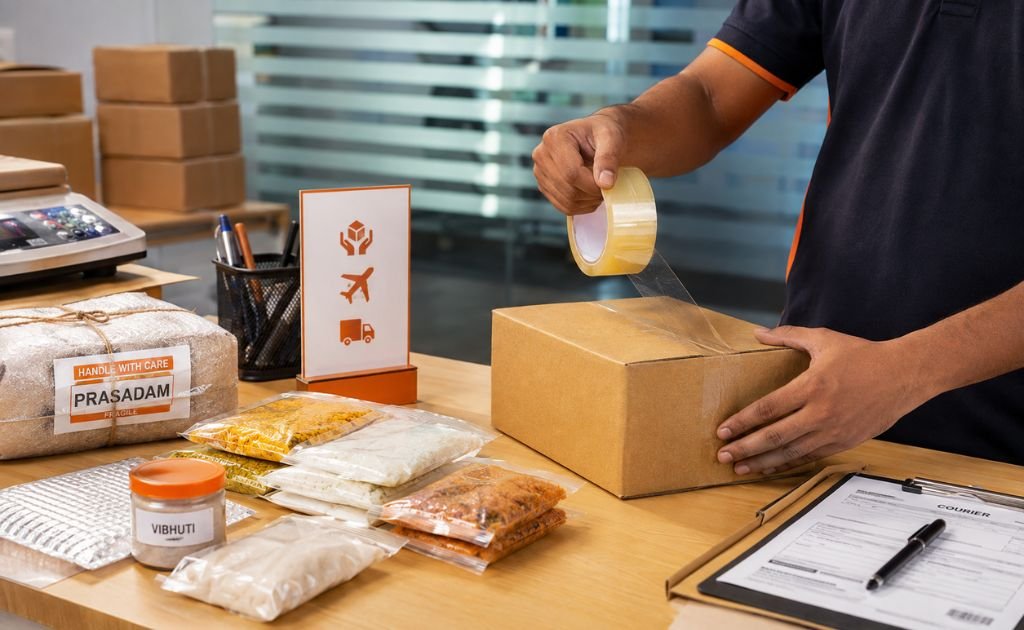

After a visit to a temple, many families want to do one simple thing: share the prasadam with people who could not make the journey. A son working in Bengaluru, parents in Delhi, a daughter settled in New Jersey. The wish is simple – the parcel is not. Prasadam may be food, perishable, fragile or prone to leaking, and once it crosses a state or a border, courier rules, food regulations and customs requirements all start to matter.
This guide explains, in practical terms, what a temple prasadam courier service actually involves: which types of prasadam can usually be shipped, how to pack them, what affects cost and delivery time, how international shipments differ, and how to arrange pickup if you are sending from Chennai.
Table of Contents
Can Temple Prasadam Be Sent by Courier?
Yes – many types of temple prasadam can be sent by courier, but not all, and not everywhere. Dry items such as vibhuti, kumkum, dry sweets and sealed packaged prasadam generally travel well when packed properly. Fresh, wet or short-shelf-life prasadam is far harder to ship, and international shipments also depend on the destination country’s food and customs rules. What can be accepted always depends on the specific item, its packaging, the carrier’s policy and the destination – which is why it is worth confirming with your courier before you book.
What Is Temple Prasadam?
Prasadam (or prasad) is an offering – most often food, but also sacred materials such as vibhuti (holy ash), kumkum or flowers – blessed at a temple and distributed to devotees, which is why families go to such lengths to share it with relatives far away. For shipping purposes, one practical fact matters most: “prasadam” is not one product. A packet of Palani panchamirtham, a box of Tirupati laddus, a pouch of vibhuti and a fresh banana-leaf offering are completely different items in the eyes of a courier – and of customs.
What Types of Prasadam Can Usually Be Sent?
The table below reflects how couriers generally treat common prasadam categories. None of these are guarantees – acceptance always depends on packaging, the carrier and the destination.
| Type of prasadam | General shipping consideration |
| Dry sweets (laddu, boondi, dry halwa types) | Often accepted, especially domestically, if sealed and cushioned; shelf life dictates service speed |
| Packaged dry food (murukku, sealed temple snacks) | Among the easiest to ship; sealed commercial-style packs travel best internationally |
| Vibhuti (sacred ash) | Usually shippable when double-sealed against spills; declare powders clearly |
| Kumkum / turmeric powders | Same as vibhuti – small, sealed, leak-proof containers |
| Religious books and pictures | Rarely a food/customs issue; pack against bending and moisture |
| Small devotional items (malas, small idols) | Generally shippable with cushioning; some materials (certain woods, antiques) have export rules |
| Fresh food (pongal, curd rice, wet sweets) | Generally unsuitable – short shelf life, leakage risk; most carriers won’t accept |
| Liquid offerings (theertham, oils, ghee items) | Restricted by many carriers; often refused for air transport without special approval |
| Fruits, coconut, flowers | Perishable and often restricted internationally under plant-material rules |
If your item is not on this list, the principle still holds: dry, sealed and shelf-stable ships well; wet, fresh and fragile needs a conversation with the courier first.
What Types May Be Restricted?
A few categories consistently need extra checking before any courier – Galaxy included – can confirm acceptance:
- Perishable food with a shelf life of only a few days
- Liquids and semi-liquids (theertham, honey- or ghee-heavy preparations) with leakage risk
- Fresh fruits, coconuts and flowers – often restricted plant material at destination
- Temperature-sensitive items such as ghee sweets in peak summer transit
- Dairy- or animal-origin ingredients in international shipments
- Anything the destination country restricts, however well packed
This is not a fixed prohibited list – rules differ by carrier and country, and they change. Tell your courier exactly what the item is and where it is going, and let them confirm against current rules before booking.
How to Pack Temple Prasadam Courier

Good packing is what turns “hopefully it arrives” into “it arrived intact.” A sensible sequence:
- Start with clean, food-grade primary packaging – never loose items or newspaper wrapping.
- Seal against moisture and air. Heat-sealed or vacuum-sealed pouches extend the safe transit window for dry foods.
- Make powders spill-proof. Vibhuti and kumkum go in rigid, tightly closed containers, taped shut, then inside a zip-lock bag – a burst powder packet can ruin the whole parcel.
- Contain anything that could leak. Oily or semi-solid items (where accepted at all) need leak-resistant secondary packaging: sealed container, absorbent layer, sealed outer bag.
- Cushion fragile containers. Jars, tins and idols need bubble wrap or foam, with no free movement inside the box.
- Keep food and non-food items separated, each sealed on its own.
- Use a strong corrugated outer box, not a reused sweet box.
- Label clearly and declare honestly. The contents description on the booking must match what is inside.
For fresh or perishable prasadam, packing alone cannot solve the problem – acceptance depends on the carrier, route and transit time, so check before you pack.
Galaxy International Couriers provides packing assistance in Chennai and follows similar principles for other sensitive shipments, from food items being sent abroad to fragile devotional items like golu dolls.
Fresh vs Dry Prasadam: Why It Matters So Much
| Factor | Dry prasadam | Fresh / perishable prasadam |
| Shelf life | Days to weeks when sealed | Often 1–3 days |
| Packaging | Standard sealed food packing usually enough | Specialised handling, if accepted at all |
| Courier suitability | Good – most carriers can consider it | Poor – many carriers decline outright |
| Transit sensitivity | Tolerates normal delays | A single delay can spoil the item |
| International shipping | Possible to many destinations, subject to rules | Rarely practical; food-safety rules add limits |
This is the single most useful filter when deciding what to send. If a relative abroad wants fresh temple pongal or a wet preparation, a sealed dry alternative – or a commercially sealed version where the temple offers one – is usually the realistic choice. No courier can promise that fresh food will stay fresh.
Sending Prasadam Across India
Domestic prasadam delivery is well established. India Post runs a dedicated “Holy Blessings” program delivering prasadam from famous temples via Speed Post, and in Tamil Nadu the HR&CE department and Department of Posts jointly deliver prasadam from 48 temples – including the Palani Dhandayuthapani Swamy Temple – booked through the HR&CE portal. Those programs are excellent when you want the temple itself to dispatch prasadam to an Indian address.
A private courier fits the cases those programs don’t cover: you already have the prasadam in hand after your own visit, you’re sending it along with other gifts, your temple isn’t part of a postal scheme, or you want doorstep pickup, tracking and a faster or more flexible service. From Chennai it works simply: the courier collects the packed parcel from your home (or you drop it at a branch), and you follow the tracking number until delivery. Transit within India commonly runs from about a day to metros up to several days for remote pincodes.
International Temple Prasadam Courier: What Changes
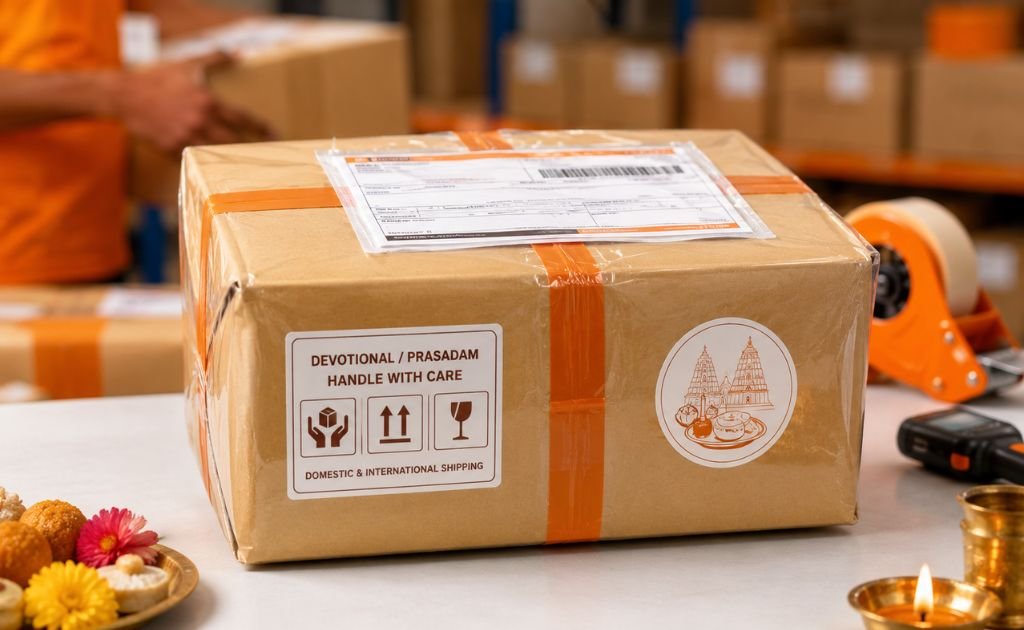
Sending prasadam overseas is where most mistakes happen, because a parcel that is routine within India becomes a regulated food import the moment it crosses a border. Four things change:
1. The destination country’s food rules apply. Many countries restrict incoming food – especially dairy-based, ghee-based, fresh or plant-origin items. The United States, for example, controls many agricultural and animal-origin products through CBP and USDA-APHIS rules; Australia and Singapore are similarly strict. Commercially sealed, shelf-stable items fare far better than homemade or loose-packed food.
2. Customs documentation matters. Declare prasadam honestly for what it physically is – for example, “packaged sweets” or “holy ash (religious item), no commercial value” – never as something vague or false. Inaccurate declarations are the fastest route to seizure or return.
3. The carrier’s own policy applies on top. DHL, FedEx, UPS and other carriers each maintain restricted-item rules, and food often needs pre-approval on specific routes.
4. Shelf life must survive customs. Transit plus possible inspection means the item needs a comfortable margin – another reason dry prasadam dominates overseas shipments.
No honest courier will tell you “every country accepts prasadam.” A good courier checks your specific item against current rules for your specific destination before accepting the booking – and declines it if it cannot travel safely and legally.
What Does a Prasadam Courier Cost?
There is no universal “prasadam courier price,” and you should be wary of anyone quoting one without details. Charges depend on weight and dimensions (international air rates use volumetric weight, so a light but bulky box can cost more than expected), the destination, whether the service is domestic or international, the speed you choose, packing requirements, and insurance where available. Most prasadam parcels are small and light, so domestic costs are usually modest; international costs follow the destination’s per-kg slab. For a realistic figure, get a quote for your actual parcel – Galaxy publishes indicative international courier charges from Chennai and provides shipment-specific quotes on request.
How Long Does Prasadam Delivery Take?
Transit time depends on destination, service type, pickup time, weekends and holidays, festival-season volumes, customs processing and weather or flight disruptions. As broad, non-binding patterns: within India, metro-to-metro express services often deliver in roughly 1–3 days, remote areas longer; international express commonly runs a few working days to a week or more once customs is factored in. Temple postal schemes publish their own dispatch windows – those apply only to those programs, not to couriers generally. During major festival periods, book earlier than you think you need to.
Sending Prasadam from Chennai
If you are in Chennai, the practical side is simple. Galaxy International Couriers operates two branches in Mylapore – at No.7, R.K. Mutt Road and at No.152, Royapettah High Road, Luz Corner – near the Kapaleeswarar Temple area, and serves the whole city with doorstep pickup, so you don’t need to travel with a delicate parcel at all. Both domestic and international courier services are available, with packing assistance and shipment tracking. Chennai is also a natural forwarding point for families returning from Palani, Tirupati, Tiruvannamalai or Rameswaram who want to send prasadam onward – within India or, where rules permit, overseas.
Why Consider Galaxy International Couriers?
A few facts, plainly stated. Galaxy International Couriers has operated from Mylapore since 2015, founded by Mohamed Rafik, who brings over 25 years of air-cargo handling experience. The company handles domestic and international shipments through partnerships with major carriers including DHL, FedEx, UPS and Aramex, and has working experience with categories close to prasadam shipping: food packing for abroad, fragile devotional items such as golu dolls, and handicrafts including pooja articles and bronze idols.
To be clear about what that means for prasadam: Galaxy assesses prasadam shipments case by case – based on the item, its packing, the destination, and what carrier and destination rules currently allow. That is the honest way to handle sacred, perishable or fragile items – and exactly what you should want from any courier you trust with them.
10 Questions to Ask Before Sending Prasadam
- Is this specific type of prasadam accepted by the courier?
- Is it accepted for my destination – domestic and/or international?
- Does the destination country allow this kind of food or material?
- Does it need special or additional packaging?
- Is the item perishable, and will it survive the expected transit time?
- What is the estimated delivery time, including customs for overseas parcels?
- What will it cost for this weight, size and destination?
- Is tracking provided, and how will I receive updates?
- What exactly should I declare on the shipment documents?
- What happens if the parcel is delayed or cannot be delivered?
Common Mistakes to Avoid
The most common failures are avoidable: sending perishable food without checking whether it can survive the journey; weak sealing that lets powders or oils escape; flimsy outer boxes; vague or inaccurate declarations; assuming international rules mirror domestic ones; sending liquids without confirming acceptance; choosing a slow service for a short-shelf-life item; incomplete recipient details (a missing phone number alone can stall a delivery); and ignoring festival and holiday delays. All of them are solved by one habit – tell your courier exactly what you’re sending and where, before you book.
Frequently Asked Questions
Can temple prasadam be sent by courier? Yes, many types can – particularly dry, sealed, shelf-stable prasadam such as vibhuti, kumkum, dry sweets and packaged items. Acceptance depends on the item, packaging, carrier policy and destination rules.
What types of prasadam are easiest to ship?
Dry and sealed items: packaged dry sweets, dry snacks, vibhuti, kumkum, religious books and small non-fragile devotional articles.
Can fresh prasadam be sent by courier?
Usually not. Fresh or wet prasadam has a short shelf life and leakage risk, and most carriers will not accept it. No courier can guarantee freshness in transit.
How should prasadam be packed for courier?
Sealed food-grade primary packaging, spill-proof containers for powders, leak-resistant secondary packaging where relevant, cushioning for fragile containers, and a strong outer carton – with contents declared accurately.
Can temple prasadam be sent outside India?
Often yes, for dry and sealed items – but it depends on the destination country’s food and customs rules. Dairy-based, fresh and plant-origin items are commonly restricted.
Can liquids such as theertham, ghee or oil preparations be couriered?
Liquids are restricted by many carriers, especially for air transport, and need specific confirmation. Never assume acceptance for liquid prasadam.
Can vibhuti and kumkum be sent by courier?
Can vibhuti and kumkum be sent by courier? Generally yes, in sealed, spill-proof containers, declared accurately – including to many international destinations, subject to that country’s rules.
What affects prasadam courier charges?
Weight, dimensions (volumetric weight for air), destination, domestic vs international, delivery speed, packing and optional insurance. Request a shipment-specific quote.
How long does prasadam delivery take?
Roughly 1–3 days between Indian metros on express services, longer for remote areas; international deliveries typically take several working days including customs. Festival seasons add time.
Doesn’t India Post already deliver prasadam?
Yes – its Holy Blessings program and the TN HR&CE scheme deliver prasadam from participating temples to Indian addresses. A private courier serves the other cases: prasadam you already have, temples outside those schemes, combined parcels, and international destinations where rules permit.
Can I send prasadam from Chennai with doorstep pickup?
Yes. Galaxy International Couriers offers doorstep pickup across Chennai and has two Mylapore branches for walk-in bookings and packing assistance.
Can Galaxy International Couriers ship my temple prasadam?
Galaxy assesses each prasadam shipment individually – based on the item, packaging, and current carrier and destination rules – rather than promising blanket acceptance. Share the item, pickup point and destination, and the team will confirm what’s possible.
Ready to Send Prasadam? Start with One Message
Have five details ready: what the item is, the pickup point, the destination, domestic or international, and the approximate weight. With those, Galaxy International Couriers can quickly confirm whether your prasadam shipment can be accepted, how it should be packed, and what it will cost.
– or call +91 99412 89341 / visit either Mylapore branch between 9:30 AM and 9:00 PM.